
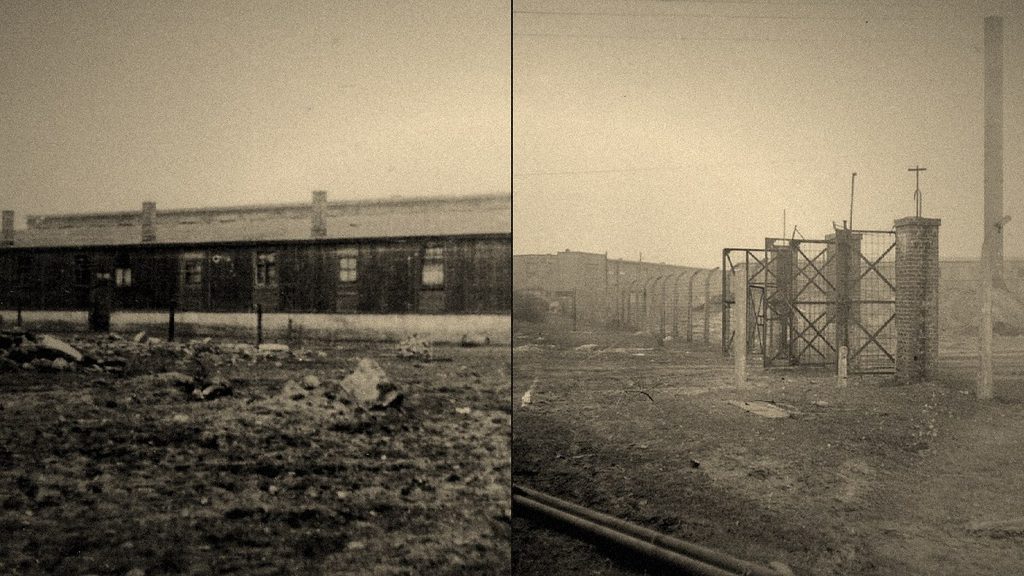
On 19 September 2026 in Jaworzno, on the grounds of the former Central Labor Camp through which thousands of Ukrainians passed, the annual ceremonies commemorating the victims of postwar communist repression were held. An event that each year draws a small group of people for whom this memory still matters. To understand why this particular place is significant, you have to go back eighty years — to a barrack of the former German concentration camp, which after the war acquired new guards.
How a Nazi camp became Stalin’s camp — and what Ukrainians have to do with it


Jaworzno is not an accidental point on the map. On 15 June 1943, the Germans opened here the KL Auschwitz sub-camp “Neu-Dachs”, in which prisoners were forced to work in coal mines for the Energieversorgung Oberschlesien concern. On 17 January 1945, with the front approaching, the Germans marched prisoners who were fit to walk on foot to the Gross-Rosen camp — and as early as 6 April 1945, under Circular No. 42 of the Ministry of Public Security, the new communist authorities formally established a Central Labour Camp in the same place. The barracks in which prisoners of the Nazi camp had previously died began to serve yet another regime.
The turning point was the death of Gen. Karol Świerczewski, shot on 28 March 1947 in a UPA ambush near Jabłonki by Baligród. A month later, on 28 April 1947, Operation “Vistula” began — the forced resettlement of the Ukrainian population from south-eastern Poland to the Recovered Territories. Even before it began, on 23 April 1947, a decision was made to send to Jaworzno people of Ukrainian nationality and Lemkos suspected of collaborating with the UPA. The first prisoners arrived at the camp at the beginning of May 1947 — roughly a week after the launch of Operation “Vistula”.
A separate sector was set aside in the camp for interned Ukrainians and Lemkos, fenced off with barbed wire from the rest of the prisoners. In total, 3,821 people passed through this sector — including 819 women, about 80 of whom were pregnant, a dozen or so children, as well as 22 Catholic priests and 5 Orthodox clergy, according to findings cited by mojejaworzno.pl. Most of them were released by the end of 1948, and the Ukrainian sector itself was formally closed on 8 January 1949. The camp itself continued operating — first as a place of internment, later as a juvenile prison — until its official closure in 1956.
The number of victims of the entire post-war Central Labour Camp, encompassing all nationalities held there in 1945–1956, exceeds six thousand people — a figure separate from the victims of the German “Neu-Dachs” from 1943–1945. What happened after 1989 is also telling: the IPN prosecutor’s office twice discontinued the investigation into crimes committed against the Ukrainian civilian population in the camp, justifying this by stating that “no acts were committed” — no charges were brought against any of the roughly eighty investigators of the then Security Office responsible for this sector, as reported by Wikipedia.
What happened yesterday
On 19 September, as every year, a commemorative ceremony took place in the forest between the Jaworzno housing estates Osiedle Stałe and Podłęże, where the burial site of prisoners of the former camp is located. On behalf of the Ukrainian diplomatic mission, the second secretary of the Embassy of Ukraine in the Republic of Poland, Vasyl Melnychuk, and the consul of the Consulate General of Ukraine in Kraków, Vitalii Serenko, took part. Melnychuk, on behalf of the Ambassador of Ukraine, Vasyl Bodnar, addressed those gathered and read out his letter.
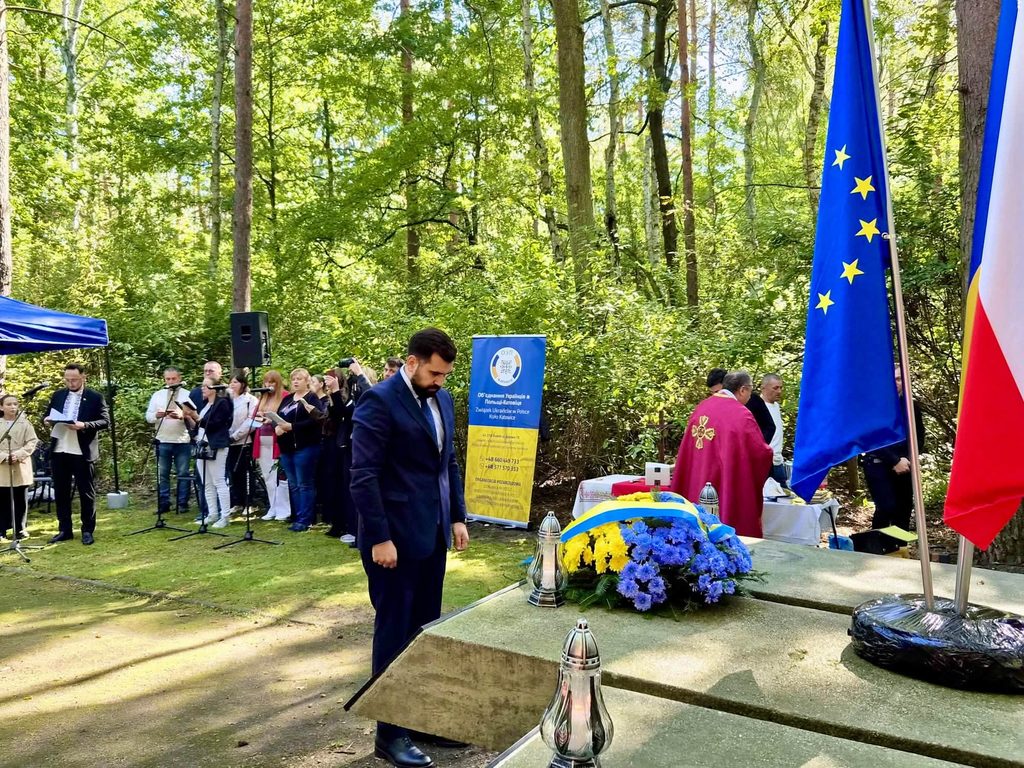
“Polish-Ukrainian history has many difficult and tragic chapters. They can neither be forgotten nor used to pass on mutual distrust to future generations. Our responsibility is to speak about the past honestly and with dignity, to listen to each other’s pain, and to seek in historical memory not reasons for new hostility, but a path to mutual understanding and reconciliation” — from a letter by the Ambassador of Ukraine in Poland, Vasyl Bodnar, read out during the ceremony in Jaworzno.
This is not a one-off action, but part of an annual ritual — similar ceremonies in Jaworzno have been held since the early 2000s, and the circle of participants — mainly descendants of prisoners, representatives of the Ukrainian community of Silesia and local authorities — remains similar from year to year, while media interest in this date tends to decline rather than grow.
Was there anything similar on the Ukrainian side?
This question naturally arises for every Polish reader—and there is an answer, although it concerns a somewhat different mechanism of repression. The Soviet authorities did not create separate “Ukrainian sectors” for their own citizens, separated on an ethnic basis, as the Polish communist administration did in Jaworzno. Instead, they built a system of suspicion based on a fundamentally different criterion—mere contact with the “foreign” world.
Millions of Ukrainians who had gone through German captivity, forced labor in the Third Reich as so-called Ostarbeiter, or who had simply found themselves in occupied territories, after 1944–1945 were sent not home but to Soviet NKVD verification and filtration camps. There they were interrogated and registered—with a fingerprint on the so-called “filtration file”—and in practice had to prove their “innocence” against the accusation of collaboration with the enemy. Those who did not pass this verification were sent further—already into the Gulag system. In early 1945 alone, as many as three million former prisoners of war passed through filtration camps—more than the total number of Gulag prisoners at that time combined.
The logic of both systems was essentially a mirror image: both Warsaw and Moscow in the postwar years treated people who had simply found themselves on the “wrong side” of the front line or the ethnic divide as inherently suspect—and in both cases the camp became a tool not of punishment for a specific guilt, but of preventive pressure on an entire group. The difference is that Poland has for decades officially recognized Jaworzno as part of its own, albeit uncomfortable, history—whereas Soviet filtration camps in Ukraine still remain a mainly academic topic rather than an object of public remembrance.
That is precisely the point of yesterday’s ceremony. Jaworzno does not offer an easy answer to the question of who was right. It offers recognition that both nations, at different moments of the 20th century, found themselves on the same side of barbed wire — and that silence about this does not make the past any lighter; it only passes its weight on, as an inheritance, to subsequent generations.
Source: Nowiny Wschodnie / Embassy of Ukraine in the Republic of Poland / IPN / Auschwitz-Birkenau Museum / dzieje.pl / mojejaworzno.pl / Wikipedia
