
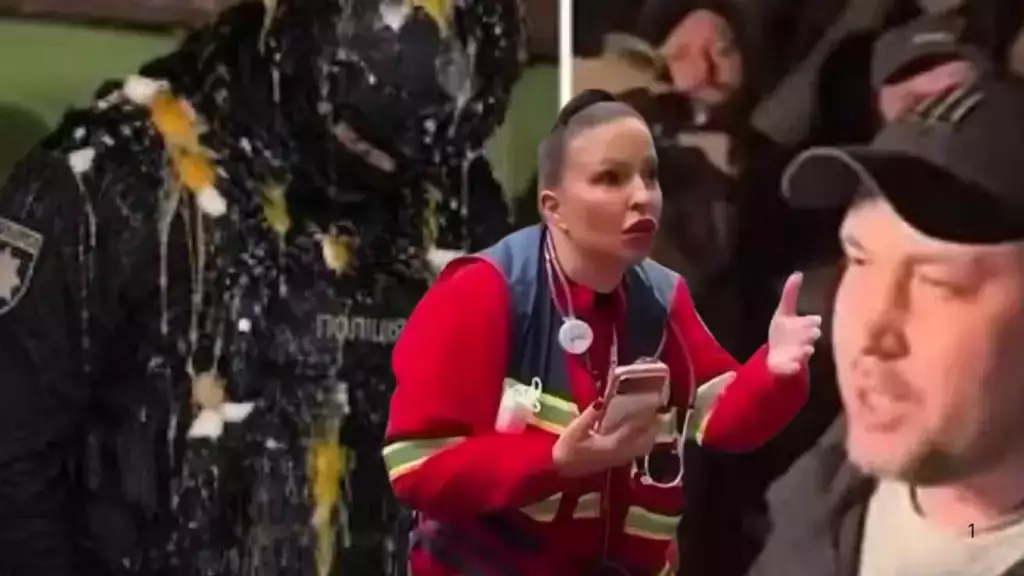
More than a hundred identified participants, paid provocateurs, women and children in the front rows, and behind them a group of men prepared for the use of force. Added to that were false reports about torture, unlawful detention of people and the death of a man. This is what the сценарий of the events of 2 November 2026 in Petropavlivska Borshchahivka near Kyiv looked like—events which, according to Ukrainian services, may have been a provocation planned in advance. Are we dealing with the return of titushky and yet another operation whose effects Russian propaganda services could exploit?
A protest that wasn’t spontaneous?


On 2 November 2026 in Petropavlivska Borshchahivka, a locality in Kyiv Oblast, violent clashes broke out near a building used by the Ukrainian National Guard. A group of people gathered at the scene demanding an explanation of the situation of the men staying there. Information very quickly began appearing on social media about the alleged unlawful detention of people, torture, and even the death of one of them.
The situation was quickly becoming increasingly tense. Some participants tried to force the gate open; the fence and windows were damaged; various objects were thrown and irritant agents were used. There were also clashes with the police and National Guard officers.
Initially, the events were presented as a spontaneous reaction by residents to information about alleged abuse of people being held in the building. However, already the next day the Ukrainian Security Service reported that the incidents could have been a pre-planned operation.
What was really in the building?
Explanations regarding the building were provided by the commander of the National Guard of Ukraine, Brigadier General Oleksandr Pivnenko. As he reported, 18 soldiers were there. Among them were four servicemen who had previously left their units without authorization and were brought back to them.
The four soldiers were then transported to a medical facility. According to information provided by the command of the 1st Corps of the National Guard “Azov”, they had injuries requiring examinations and medical consultations. The military authorities announced that they would verify the circumstances in which they occurred. This is a very important detail, proving that not all information about irregularities was fabricated. The soldiers’ condition and the way they were treated required clarification. However, this does not mean that the stories circulated on the internet about torture, unlawful detention, or a person’s death were true. These reports were denied, and the soldiers’ families also had the opportunity to ознакомиться with the conditions of their stay.
However, it should be clearly emphasized that the matter did not end with the explanations provided by the National Guard command. On 3 November, Ukraine’s State Bureau of Investigation announced the opening of a separate criminal proceeding. Investigators are to examine, among other things, the conditions of the soldiers’ stay in the building and information about any possible use of coercion against them. An inspection concerning the observance of service members’ rights—both of those detained after leaving their units without authorization and the newly mobilized—was also launched by the office of Ukraine’s Soldiers’ Rights Ombudsman.
More than one hundred identified participants
On 3 November, SBU Deputy Head Ivan Rudnytskyi stated at a press conference that the services had identified over 100 people who were present at the scene and took part in the events described. Some of them were searched, and investigators were considering detentions and bringing charges. According to Rudnytskyi, the organizers of the events intended to bring about the unlawful removal of one of the National Guard soldiers from the unit’s stationing location. To this end, they were allegedly to provoke violent riots and public outrage.
A fake medic and a paid accomplice
The most specific information was provided by an SBU statement of 4 November. The service reported the detention of three people suspected of organizing the provocation. According to investigators’ findings, preparations began as early as 30 October. One resident of Kyiv Oblast was allegedly tasked by another woman with escorting a National Guard soldier out of the facility. The plan involved staging an urgent, sudden need to provide him with medical assistance.
The woman was allegedly posing as a healthcare worker. To carry out the plan, she also involved an acquaintance who, for payment, agreed to play the role of a paramedic. As it later turned out, the vehicle used did not belong to any medical facility. What is particularly important, according to the SBU, the man conducted reconnaissance near the National Guard’s deployment site even before the riots.
On 2 November, the woman appeared near the facility and began posting on social media information intended to spark public outrage. This was meant to lead to a gathering of people and provoke riots.
While reviewing the phone of one of the suspects, investigators found correspondence with other individuals in which scenarios for actions against Ukrainian soldiers were discussed. The SBU also reported the detention of another woman who actively took part in the incidents and called for blocking and damaging a National Guard bus.
Women and children in front, behind them titushky
An even more detailed picture of the preparations for the riots was presented on 3 November by the Ukrainian portal LIGA.net. According to a source of the portal connected with the special services, at least a hundred young men were to be brought to the scene of the events. Another informant reported that the group intended for forceful actions had been recruited for pay a week before the events. According to the portal’s interlocutors, the organizers were to use a proven modus operandi: at the head of the gathering were women and children, who were to shout and evoke the appropriate emotions, while behind them were men prepared for more decisive actions. It was precisely for this second group that the informants used the term well known in Ukraine: “titushky.”
Specific amounts were also given. Each participant in the operation was promised remuneration of 4,000 to 4,500 hryvnias. Additional money was to be granted to those who would incite others, call in law enforcement services, or attempt to force their way onto the premises occupied by soldiers.
If these accounts are confirmed in the course of the investigation, we will be dealing with a mechanism far more complex than a spontaneous gathering of dissatisfied residents. It would involve preparing the entire event in such a way as to conceal, under the guise of a peaceful protest, a group of provocateurs prepared in advance.
Titushky – a symbol of provocation from the Yanukovych era
The term “titushky” is not accidental. It has been used in Ukraine since 2013 and has a very specific historical meaning. The term originally referred to young men with an athletic build, often dressed in tracksuits, who were used to provoke brawls, intimidate demonstrators, and physically break up protests directed against the authorities at the time. Their task was to cause chaos and violence, which could then be used to portray the protesters in a negative light. The word itself comes from the surname of the athlete Vadym Titushko, known by the pseudonym Rumin.
The incident that marked the beginning of the history of this term took place on 18 May 2013 in Kyiv. That day, two parallel political demonstrations were held: the opposition action “Rise up, Ukraine!” on Sofiyska Square and a rally of the Party of Regions on European Square. Near the Intercontinental hotel on Velyka Zhytomyrska Street, a fight broke out between opposition representatives and a group of young, well-built men. The event was filmed by journalists, who were then attacked. Among those detained on suspicion of assaulting media representatives was Vadym Tituszko. Three other people were also charged. In September 2013, sentences were handed down—custodial terms with their execution conditionally suspended.
The term quickly became established in the Ukrainian information space. As early as July 2013, it entered the online dictionary of the contemporary Ukrainian language. Since then, it has referred not only to street hooligans but, above all, to people used to organize provocations, intimidate opponents, and disrupt peaceful civic activities.
In the case of the incidents near Kyiv, there are indications pointing to a mechanism resembling the actions of titushky. The SBU claims that at least some individuals were recruited for money, a provocation сценаріо was prepared, reconnaissance of the site was carried out, and then social media was used to incite unrest.
However, there are no grounds to claim that all participants in the disturbances were paid provocateurs. Nor should all individuals identified by the SBU be equated with the organizers of the operation. One can, however, speak of a mode of operation resembling methods known in Ukraine from the times of Viktor Yanukovych’s rule.
A Russian trail? Who benefits from such an image of Ukraine?
In the whole matter, the way social media was used is particularly interesting. Before the riots broke out, information began to appear about alleged torture, unlawful detention of people, and the death of one of the men. These contents stirred emotions and encouraged residents to intervene.
SBU Deputy Chief Ivan Rudnytskyi drew attention to the manipulative nature of the disseminated information. Ukrainian services also analyzed the way it was distributed. According to media reports, some of the messages about the events were intensively spread by Russian information channels.
Radio Svoboda presented interesting findings in this case. Information-warfare expert Dmytro Zolotukhin pointed out that as early as around 13:30, information about the events began to be disseminated by a large number of popular Telegram channels. In his view, the scale of publicity was disproportionate to the event’s initial significance. He also noted a large number of comments bearing the hallmarks of bot activity. Meanwhile, serviceman Serhii Hniezdilov reported that he had received a message about an alleged torture site in Petropavlivska Borshchahivka as early as 1 November, i.e., the day before the riots erupted.
Additional controversy was sparked by the case of a 14-year-old boy who appeared on the premises of the facility. According to information from Ukrainian media, the teenager was supposed to have gotten there after classes by climbing over the fence. During the commotion he was injured and taken to hospital. The case gained additional notoriety after the boy and his parents were entered into the database of the Ukrainian portal Myrotvorets. They were attributed participation in actions against Ukrainian soldiers. The entry caused controversy, especially due to the teenager’s age and the lack of a final legally binding determination of his possible responsibility. It is worth emphasizing that Myrotvorets is not a state body or a court, and placing someone in its database does not constitute proof of committing a crime.
Russia and the fight over Ukraine’s image
The above findings do not automatically mean that Russian services commissioned and financed the entire operation. As of 4 November, no evidence had been presented publicly that would allow this to be confirmed unequivocally. However, one cannot ignore the question of who, and for what purpose, could have prepared a similar provocation, and who might benefit most from its consequences.
Ukraine’s Minister of Foreign Affairs Andrii Sybiha also referred to the Russian context of these events. He stated that the publicity given to the provocation is driven by an adversary attempting to exploit Ukraine’s existing internal problems to destabilize the situation in its rear. A similar possibility of external influence had previously been indicated by the head of the Office of the President of Ukraine, Kyrylo Budanov.
These statements strengthen suspicions regarding the Kremlin’s Russian involvement in the provocations near Kyiv. Russia has long been conducting information activities aimed at undermining Ukraine’s credibility and weakening support for it in Western countries. The image of Ukraine as a state in which people are allegedly tortured, unlawfully deprived of their freedom, and subjected to violence by their own authorities fits perfectly into this narrative. Such messaging is particularly useful in countries whose societies support Ukraine and finance assistance for it. Its purpose is to sow doubt, weaken trust in Ukrainian institutions, and consequently provide arguments to opponents of further support.
Not all information about abuses in Ukrainian military structures must mean Russian disinformation. Real cases of lawbreaking must be clarified, and those responsible should face consequences. The problem begins when isolated incidents become a pretext for undermining the credibility of the entire state. Russia does not have to create every crisis on its own. Sometimes it is enough that it can exploit existing problems, stoke emotions, and appropriately publicize events that cast Ukraine in a bad light. In this case, once again, it achieved its intended goal.
Eight years in prison and further investigation
On 4 November, the SBU reported the detention of three people and the filing of charges against them. The charges concern obstructing the activities of the Armed Forces of Ukraine and the unauthorized dissemination of information about the deployment of Ukrainian military formations under martial law. The alleged acts carry a penalty of up to eight years’ imprisonment. Investigators filed motions with the court to apply pre-trial detention. Further action against the remaining persons involved in the provocation was also announced. For now, these are charges, not final verdicts.
As early as 4 November, information appeared about a decision by the District Court in Kyiv’s Solomianskyi district, which imposed on Valentyna Moloda—a woman who acted as a medic during the activities and who had been spreading online information about the alleged detention and torture of soldiers—pre-trial detention for 60 days, with no possibility of posting bail. Moloda presented herself as a healthcare worker, and the car she arrived in bore markings of a medical facility that is no longer operating. The detention is to remain in force until 2 January 2027. On the same day, the Kyiv Oblast Prosecutor’s Office reported that the court had also decided to detain a second suspected woman, without the possibility of bail. According to investigators’ findings, she was to have initiated the blocking of a military building and involved other people in this action, seeking to have a soldier acquaintance leave the unit.
Provocation, disinformation, and the battle for Ukraine’s image
The events in Petropavlivska Borshchahivka show how easily existing social tensions can be exploited to trigger a serious conflict. There is no need to invent problems from scratch. It is enough to find a real issue that stirs emotions, present it in a suitably manipulated way, involve a few people, and bring about a situation in which the crowd’s spontaneous reaction becomes an element of a pre-prepared сценарza.
In Ukraine, mobilization is a particularly sensitive topic. There are cases of abuse by representatives of the structures responsible for conscription, there are problems related to the treatment of soldiers, and families, which should surprise no one, have the right to demand information about their loved ones.
Can the people involved in the events near Kyiv be called modern-day titushky?
The modus operandi of some of them indeed resembles the methods used by hired provocateurs from the Yanukovych era. But was Russia behind the whole operation? The Ukrainian investigation must provide an answer to that question.
One thing is certain: information warfare quite often begins on the street, with a carefully prepared provocation whose effects reach far beyond the scene of the incident. It does not always start with a false message published by news portals operating on the Kremlin’s orders. It is enough for the image of Ukraine as a state in which people are allegedly tortured, unlawfully deprived of their freedom, and violence is used against its own citizens to start taking on a life of its own on social media. It does not really matter whether all the information being spread turns out to be true. What matters is the first impression, the emotions, and the reach such a message achieves. Even if corrections, official clarifications, and the results of an investigation appear later, the original story may already be functioning as supposed proof of the brutality of the Ukrainian state.
The events near Kyiv show, however, that the problem does not end with the provocation itself. What happens afterward is equally important. Entering a 14-year-old boy and his parents into the Myrotvorets database, regardless of the circumstances and the intentions of those responsible for that decision, provided yet another piece of material for criticizing Ukraine. In this way, an incident whose circumstances still require clarification began to generate further controversies. It is precisely such situations that can later be exploited by Russian propaganda to build a narrative about chaos, lawlessness, and a lack of respect for human rights in Ukraine.
For Russia, it is enough that Ukraine itself provides its opponents with arguments, and the Russian propaganda machine will publicize and exploit them accordingly. That is why the fight against disinformation is not limited solely to exposing Russian lies. It also requires a reliable explanation of real abuses. Because in an information war, credibility is just as important as the ability to recognize the opponent’s propaganda.
Sources: SBU Portal – The SBU identified more than 100 people who took part in clashes in Petropavlivska Borshchahivka; Glavcom – The SBU detained three organizers of the riots in Petropavlivska Borshchahivka; Liga.net – “Women and children in front, and then titushky.” Sources: the riots in Borshchahivka were planned; Detector.media – The term “titushky” began to be used by Western media; Gazeta.ua – How Vadym Titushko’s surname became known around the world; Ukrinform – The court ordered pre-trial detention for a participant in the clashes in Petropavlivska Borshchahivka; Armyinform – No bail: two suspects in the riots in Petropavlivska Borshchahivka were taken into custody, the prosecutor’s office revealed new details; Radio Svoboda – New facts and a chronology of events in Petropavlivska Borshchahivka; State Bureau of Investigation of Ukraine – The State Bureau of Investigation has opened criminal proceedings regarding the events in Petropavlivska Borshchahivka in the Kyiv region
Journalist, columnist, author of books about Ukraine, tour guide, and commentator on developments in Ukraine and Polish-Ukrainian relations.
A certified guide to Odesa, the Odesa catacombs, Ukrainian Bessarabia, and Kyiv. He is the author of numerous publications on Ukraine’s history, culture, and contemporary affairs, some of which have been translated into Ukrainian and published in Ukraine. In 2020, he received the honorary title of Ambassador of Odesa in Poland from the Mayor of Odesa.
On 24 February 2022, the day Russia launched its full-scale invasion of Ukraine, he was in Odesa. He remained there for several months, helping coordinate humanitarian aid and reporting on the war for Polish media outlets. He described his experiences during this period in his book Odessa 4.5.0.
At Nowiny Wschodnie, he publishes articles and commentary on the Russo-Ukrainian war, Russian propaganda and disinformation, Ukrainian history, particularly that of Odesa, as well as Polish-Ukrainian relations and changing public attitudes.
He collaborates with Ukrainian newsrooms and online news outlets and appears in Polish media as a commentator on Ukrainian affairs.
What do you think about this story?
Join the conversation. Please keep comments relevant to the article.
Write a comment