
How artificial intelligence, manipulated images and disinformation exploit real social and historical disputes


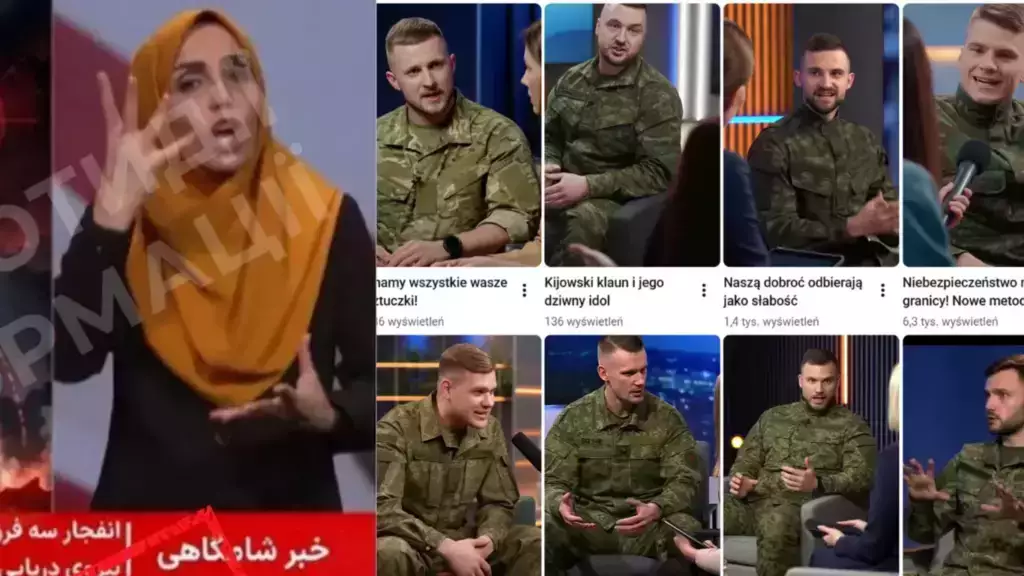
In 2026, recordings generated by artificial intelligence appeared in the Polish online space, depicting fictional Polish soldiers accusing Ukrainians of ingratitude. A few months later, a falsified image attributed to Iranian state television was also circulated, suggesting the threat of a missile attack on European cities. Both cases show how easy it is to exploit real social and geopolitical tensions to spread false information.
He has a Polish uniform, a serious expression and a firm opinion about Ukrainians. He is missing only one thing: he does not exist.
Who is behind these videos? What we don’t know
In the summer of 2026, recordings resembling street interviews circulated online. The “soldiers” accused Ukrainians of ingratitude and blamed refugees for an increase in crime. The figures and statements were generated using artificial intelligence. The videos were posted on YouTube, TikTok, Facebook and Instagram. Ukraine’s Center for Countering Disinformation and Polish newsrooms warned about them. (PAP – Recordings showing AI-generated “Polish soldiers” are circulating online, 21.07.2026; Demagog – The voice of Polish soldiers? It’s actually AI in the service of the Kremlin, 15.07.2026).
Detecting a fake recording does not, however, reveal who commissioned, financed, and disseminated it. Identifying manipulation does not prove authorship.
Demagog assesses these materials as part of activities serving the Kremlin’s interests. This does not mean, however, that the identity of specific authors or those commissioning the recordings has been established. Operation Matryoshka shows how this mechanism works in practice. (Demagog – Fake accounts, non-existent articles, and Russian ties: how Operation Matryoshka still works). Artificial intelligence tools speed up the production of content, but on their own they do not reveal the identities of its authors.
This is not an isolated case: fake media and deepfakes
A fabricated piece impersonating Euronews retained the layout of a real report, but the journalist’s voice was replaced with an AI recording that, without evidence, blamed a Ukrainian refugee for a fire in Crans-Montana. The same pro-Russian Telegram channel circulated a fake piece bearing the BBC logo about alleged disappearances of Ukrainian women. This was impersonation of the credibility of well-known newsrooms, not publications by those newsrooms. (Euronews, 16/01/2026 – Voices of Euronews journalists used in fake anti-Ukrainian recordings).
Manipulated recordings of American actors portrayed them as if they were calling on Europe to force Zelenskyy to accept an agreement on Russia’s terms. Researchers pointed to similarities with Matryoshka methods: anonymous, new accounts posted nearly identical messages within a short time. There is no evidence that the actors actually said these words. (Euronews, 24.02.2026 – Deepfake videos used against Ukraine and the EU).
AFP analyzed more than 70 accounts spreading hyper-realistic footage of alleged Ukrainian soldiers who were crying, surrendering, or talking about forced mobilization. The EEAS describes the Overload operation, also known as Matryoshka, as a Russia-linked network using media impersonation and manipulated content. This does not mean that every video can be attributed to a specific service. (GADMO / AFP – Crying soldiers, alleged desertions: how AI videos distort the picture of the war in Ukraine; EEAS – FIMI Threat Report, March 2026).
A false threat attributed to Iranian television
On 4 November 2026, screenshots allegedly originating from a program on Iran’s state television IRINN began circulating on social media. They showed a map of Europe with Kyiv, Lviv, and Odesa marked, along with a caption suggesting that Iranian missiles could reach Europe. Later Polish publications also pointed to the marking of Rzeszów. However, Ukraine’s Center for Countering Disinformation determined that the circulated screenshot had been falsified, and the original broadcast contained no information about possible strikes on Ukrainian cities. Details were described by RBC-Ukraine, Hromadske Radio, and the Polish portal o2.pl. (RBC-Ukraine; Hromadske Radio; o2.pl – Is Rzeszów Iran’s target? The “map” spread online).
This case shows how easily geopolitical tensions and real public fears can be used to create a false picture of a threat. All it takes is a fabricated frame, attributing it to state television, and rapid dissemination on social media.
The circulated material was presented as proof of an official threat before its authenticity was challenged by Ukraine’s Center for Countering Disinformation. This is not evidence of Iran’s military intentions, but an example of manipulation that exploits Iran’s image.
Volhynia: real memory, vulnerability to manipulation
The Volhynia massacre is part of a real and painful history.
Poland has the right to demand the truth, exhumations, and dignified commemoration of the victims.
That is why the memory of these events can be used in disinformation operations. Criticism of the decisions of Ukraine’s authorities is not automatically pro-Russian; one can defend historical truth while also rejecting unverified materials.
Is every criticism of Ukraine disinformation?
Anti-Ukrainian sentiment also has domestic sources: social tensions, political decisions, economic concerns, and war fatigue. Criticism of Kyiv’s policies, benefits, or trade rules is not disinformation in itself.
My perspective as an Iranian living in Poland comes from the experience of living in a country where political messaging can hijack public debate. I know how easily criticism is portrayed as betrayal, and questions as the enemy’s activity. I am not comparing Poland to Iran—the situations are different. Yet I see a common danger: the loss of trust in the media, institutions, and other people serves those who want to pit society against itself.
Poland has the right to debate aid for Ukraine and the history of Volhynia; Ukrainians have the right to disagree with the Polish assessment. These differences must not be covered up with fake recordings. Patriotism also means, to me, defending the truth—even when it is inconvenient for one’s own side.
Before you believe and share
Who is the original source? Can we determine who published the material first, or do we only know the accounts that are re-posting it?
What confirms authenticity? Is there an original recording, a verifiable place and date, or only a convincing image and voice?
Do independent sources confirm the facts? Or are they all repeating information coming from a single anonymous account?
Is there evidence of coordination? Identical posts and a sudden surge in publications may be a warning sign, but they do not in themselves prove the involvement of a foreign state.
What did fact-checkers actually establish? Did they demonstrate a forgery, or did they also identify its author? These are two different things.
In this article, the term “confirmed” refers to information described by the indicated editorial teams, institutions, or fact-checking teams. Conclusions about possible social effects and the goals of operations are my opinion and interpretation. Where sources do not identify the perpetrator of specific material, I do not categorically attribute it to any state or services.
Possible goal: loss of trust
Russia did not create all Polish-Ukrainian disputes, and not every anti-Ukrainian publication is its operation. Documented information activities, however, exploit existing tensions to weaken cooperation between the two states. Defense should not consist of banning criticism, but of distinguishing a real problem from fabricated evidence. Sources: PISM – Escalating the Polish-Ukrainian dispute: Russia’s operational objective in Poland, 24.08.2026; Reuters – Russia exploits Poland-Ukraine dispute to step up disinformation campaign, 14.08.2026.
Poland and Ukraine do not have to agree on matters of history or politics. But they must recognize the moment when someone tries to turn these differences into a tool of hostile influence.
A fake soldier may disappear from the platform. Distrust remains longer.
Iranian researcher and analyst specialising in Middle Eastern geopolitics, Iranian politics, and international security. He has published articles on Iran’s nuclear programme and Iranian-Russian cooperation, including on the BiznesAlert news portal.
He holds a Master of Business Administration (MBA) degree. He pursued doctoral studies in economics, finance, and management for five years at the Krakow University of Economics.
At Eastern News, he analyses international political and economic developments, armed conflicts, and great-power competition, with particular emphasis on their impact on the security of Poland, Ukraine, and Europe. In his publications, he combines his knowledge of Middle Eastern affairs with an economic and strategic perspective.
What do you think about this story?
Join the conversation. Please keep comments relevant to the article.
Write a comment