
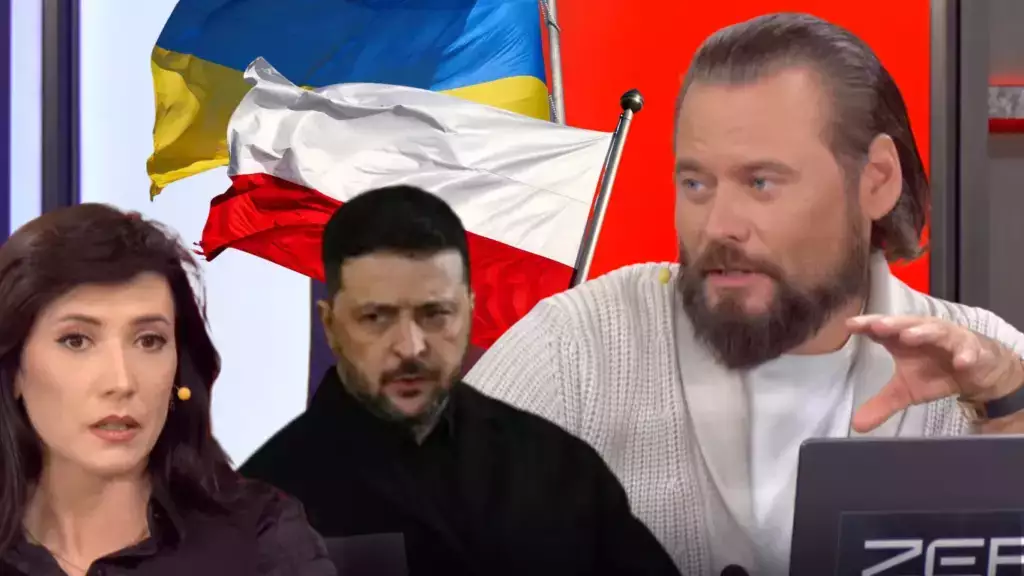
Watching on air Channel Zero Krzysztof Stanowski’s interview with Ewa Zajączkowska-Hernik, MEP of the Confederation, we paid particular attention to the fragment of the conversation starting around 42. minutes of the program. It discussed topics related to Volodymyr Zelensky, the president of Ukraine, the war with Russia, Russian agents in Poland, corruption, and the possibility of ending the conflict.


These issues are particularly close to the subject matter of our portal, which is why we at Nowiny Wschodnia decided to present this part of the interview to our readers.
We don’t intend to analyze each statement in detail or impose our own interpretation. We primarily want to present a dialogue between a MEP representing the right-wing Confederation and a journalist and founder of Channel Zero, who repeatedly asked her questions requiring specific answers.
Interestingly, at several points during the interview, Zajączkowska-Hernik struggled to provide examples to substantiate her earlier claims. Stanowski himself also noted this, openly admitting at the end of this part of the interview that he expected the MEP to be better prepared for the discussion.
Perhaps the politician didn’t attach such importance to these details, perhaps she didn’t remember them at the time. We won’t dwell on that.
We therefore give the floor to our interlocutors, leaving the evaluation of their arguments to our readers.
“If someone doesn’t kneel before Ukraine, he is already a Russian agent”
It all started with a discussion about Russian propaganda, the influence of Russian services and accusations against politicians in Poland.
Ewa Zajączkowska-Hernik argued that in the Polish public debate, people presenting different views are sometimes referred to with further offensive labels.
She recalled that political opponents were called fascists, and people opposing restrictions introduced during the pandemic were called “plastic wrappers.”
She then related this situation to current discussions about Ukraine.
Ewa Zajączkowska-Hernik:
“Now, if someone doesn’t kneel before Ukraine, but rather emphasizes Polish interests in international relations, then he is already a Russian agent.”
At this point, Krzysztof Stanowski interrupted her statement, asking what exactly Poland’s interest in international relations would be.
Krzysztof Stanowski:
“What is this interest in international relations? Is it common interests with Russia or with other countries?”
Ewa Zajączkowska-Hernik:
“Mr. Editor, I have no idea what you’re trying to impute to me here. Let’s not take this discussion to absurd lengths.”
The MEP continued her argument, arguing that calling political opponents Russian agents too often could be counterproductive.
In her opinion, if almost anyone can be publicly accused of collaborating with Russia, it becomes more difficult to identify someone actually working for Russian intelligence.
The politician stressed that if anyone has evidence of a specific politician’s collaboration with Russian services, they should present it.
Stanowski pointed out, however, that proving agent activity is not always easy.
Krzysztof Stanowski:
“Sometimes it’s hard to prove, sometimes it takes decades, as we recently saw in Germany, where an old man was basically caught for being a Russian agent for years.”
The journalist stressed that Polish services should also be given time to detect people actually collaborating with foreign intelligence.
Stanowski recalls his statement about Zelensky. “I felt a shiver of embarrassment.”
The conversation then moved on to the war in Ukraine.
Krzysztof Stanowski reminded the MEP of her earlier statement on Radio ZET, in which she spoke about Volodymyr Zelensky’s responsibility for prolonging the war with Russia.
The journalist admitted that hearing these words sent “shivers of embarrassment” through him.
Krzysztof Stanowski:
“Do you really think that Ukraine is responsible for prolonging the war with Russia?”
Ewa Zajączkowska-Hernik:
“I don’t believe Ukraine is responsible for prolonging the war with Russia. I believe President Zelensky is unwilling to negotiate because he is currently protected by presidential immunity, as are his colleagues, so his government cannot be held accountable for embezzling billions of euros that have flowed into Ukraine.”
This was one of the most controversial moments of the conversation. The MEP linked Zelensky’s lack of willingness to negotiate with his alleged avoidance of responsibility for embezzlement.
However, in the above-mentioned conversation she did not present any evidence confirming such a motive for the Ukrainian president’s actions.
Krzysztof Stanowski:
“Don’t you see anything inappropriate in these words?”
Ewa Zajączkowska-Hernik:
“No, absolutely.”
Krzysztof Stanowski:
“Is there anything wrong with you believing that the president of Ukraine is prolonging the war? How could he possibly end it quickly?”
Stanowski then presented his own response.
Krzysztof Stanowski:
“I see one way to do this. Russia would have to withdraw from the Ukrainian lands it has invaded, and then I think President Zelensky would agree to end this war the next day.”
The Minsk Agreements. Who is responsible for the escalation of the conflict?
The MEP replied that the Russian-Ukrainian conflict has been ongoing since 2014, recalling the Minsk agreements signed in 2014-2015.
In her opinion, both parties violated the agreements made at that time.
Ewa Zajączkowska-Hernik:
“It’s not just Russia that violated, and it’s not just Ukraine that violated. Both sides, despite the agreements they had reached, conducted guerrilla and offensive operations, leading to the escalation of the conflict.”
Stanowski immediately asked for specific examples.
Krzysztof Stanowski:
“What actions did Ukraine take? Excuse me, what actions did Ukraine take after 2014 to expand the conflict with Russia?”
Ewa Zajączkowska-Hernik:
“Mr. Editor, if I can comment, I will respond to you.”
Instead of immediately listing specific events, the MEP began to present her assessment of European policy.
She spoke about the European People’s Party, the centre-left, the left in the European Parliament and the President of the European Commission, Ursula von der Leyen.
According to Zajączkowska-Hernik, European politics is dominated by “pro-war rhetoric.”
Ewa Zajączkowska-Hernik:
“I look at it from the perspective of a politician who observes the behavior of European politicians, observes the behavior of the European People’s Party, observes the behavior of the center-left in the European Parliament, the left, observes the behavior of the head of the European Commission. And there, the rhetoric is the same. There, the rhetoric is pro-war.”
The MEP argued that Russia and Ukraine should sit down at the negotiating table and work out the conditions for ending the war.
Stanowski, however, asked what this would mean in a situation where Russia occupies part of Ukrainian territory.
“How many rooms do you have in your house?” – the question that changed the course of the conversation
At some point, Krzysztof Stanowski decided to use an unusual comparison.
Instead of another question about international negotiations, he asked the MEP about her apartment.
Krzysztof Stanowski:
“How many rooms do you have in your house?”
Ewa Zajączkowska-Hernik:
“What does that have to do with anything?”
Krzysztof Stanowski:
“Tell me, madam.”
Ewa Zajączkowska-Hernik:
“But what does that have to do with anything?”
Krzysztof Stanowski:
“No, no, three or four or five or two.”
Ewa Zajączkowska-Hernik:
“Two”.
Krzysztof Stanowski:
“And if they take one of you and after two years someone tells us to somehow reconcile, will you be okay with that or not so much?”
Ewa Zajączkowska-Hernik:
“Great comparison, really.”
Krzysztof Stanowski:
“Why not?”
Using this example, the journalist tried to show the problem of negotiating peace with a country that has occupied part of its neighbor’s territory.
The MEP did not share his arguments and returned to the issue of the need to end the war.
She argued that further military action would not serve ordinary Ukrainians, and that resolving the conflict required agreeing on terms acceptable to both sides.
Stanowski asked whether, in the current situation, this would not mean ending the war on Russian terms.
Zajączkowska-Hernik pointed to earlier attempts at negotiations in Istanbul and the diplomatic actions of the United States.
“This looks like some kind of money laundering operation”
Later in the conversation, the MEP returned to the issue of financial aid provided to Ukraine by the European Union.
She argued that there is serious financial abuse in Ukraine and that some of the transferred funds may go to people involved in corruption.
Ewa Zajączkowska-Hernik:
“When I see billions of euros being transferred to Ukraine, it looks like some kind of money laundering operation. Really.”
Zajączkowska-Hernik also mentioned the dispute over the Ukrainian National Anti-Corruption Bureau (NABU) and the protests of Ukrainian society in defense of the independence of anti-corruption institutions.
According to the MEP, the issue of corruption should be an important element of the discussion on further financial assistance for Ukraine.
Stanovsky did not dispute the existence of a corruption problem, but again drew attention to Russia’s responsibility for the invasion.
Krzysztof Stanowski:
“I look at the map of Europe and I don’t see the moment when Ukraine entered Russian territory, but I do see the moment when Russia entered Ukrainian territory.”
Ewa Zajączkowska-Hernik:
“Russia attacked Ukraine and I have no doubt about it and I do not dispute it.”
It is worth noting here that corruption problems in Ukraine and disputes over the functioning of state institutions are not in themselves evidence for the claim that Zelensky is deliberately prolonging the war to avoid responsibility for embezzlement.
“I thought you knew what you were talking about”
At the end of this part of the interview, Krzysztof Stanowski returned to the question that had previously remained without a specific answer.
This concerned Ukraine’s actions after 2014, which, according to the MEP, were intended to escalate the conflict with Russia.
Krzysztof Stanowski:
“And what were all these things, all these bad deeds of Ukrainians after 2015 that led to the escalation and to the war with Russia?”
Ewa Zajączkowska-Hernik:
“Please forgive me, but I can’t remember now.”
Krzysztof Stanowski:
“Because you said it ten minutes ago.”
Ewa Zajączkowska-Hernik:
“I do remember the outline of the Minsk Agreements, but please forgive me, but I will not mention the details now.”
Krzysztof Stanowski:
“I thought you knew what you were talking about, honestly.”
The MEP stressed that she did not claim that Ukraine was complicit in starting the war, but that both sides violated the Minsk agreements.
Stanowski, however, did not hide his disappointment with her answers.
Krzysztof Stanowski:
“I must admit, I was hoping you’d have a better handle on this. And honestly, I’m a little disappointed.”
The journalist stressed that after the earlier discussion on Radio ZET about the MEP’s statement, he expected more detailed preparation for the conversation.
Ewa Zajączkowska-Hernik:
“I have prepared a response, Mr. Editor, but I honestly admit that I do not remember the details at the moment, all the issues concerning the agreements.”
They finally agreed on one thing
Despite numerous disputes, the interlocutors found one point of agreement.
Krzysztof Stanowski:
“But we can agree on one thing: Russia is a criminal country and it is responsible for the war in Ukraine.”
Ewa Zajączkowska-Hernik:
“But I never denied it.”
Stanowski then mentioned Grzegorz Braun, pointing out that in conversations with him it was difficult to obtain an unequivocal condemnation of Russian actions.
The MEP reiterated that she does not question Russia’s responsibility for the attack on Ukraine.
Krzysztof Stanowski:
“Well, I’m glad we at least have an agreement on this matter.”
We leave this conversation to the readers’ judgment.
The presented fragment of the interview shows how differently one can perceive the issues of the war in Ukraine, relations with Russia, financial aid and peace negotiations.
Ewa Zajączkowska-Hernik repeatedly emphasized the need to end the war and take into account the interests of Poland and ordinary Ukrainians. Krzysztof Stanowski, however, focused on Russia’s responsibility for the aggression and demanded specific examples to support the MEP’s claims.
Some of the politician’s answers were elaborate, while in others she admitted she couldn’t remember the details. The journalist openly expressed his disappointment.
Was the MEP insufficiently prepared for this part of the conversation? Or perhaps she simply didn’t consider Stanowski’s detailed questions crucial to presenting her own position?
We do not want to answer these questions for our readers.
As the editorial team of Nowiny Wschodnie, we decided that it would be worthwhile to present this discussion primarily in the form of a dialogue, allowing everyone to independently evaluate the arguments of both interlocutors.
We invite you to discuss in the comments below the article and on our Facebook profile.
Source: Channel Zero, Krzysztof Stanowski’s interview with Ewa Zajączkowska-Hernik. This material is based on a shared transcript of selected excerpts from the interview. Quotes require comparison with the original recording before publication.
Journalist and Editor-in-Chief of Nowiny Wschodnie, a news platform followed by more than 140,000 people on social media. A graduate in Journalism and Social Communication, he has been co-creating and developing Nowiny Wschodnie since 2017. He gained professional experience working with local and international media.
He specializes in fact-checking, countering disinformation and propaganda, and information security. His work focuses on Poland, Ukraine, Eastern Europe, and Polish-Ukrainian relations. He is also the founder of a non-profit organization working in the fields of integration and intercultural dialogue.
What do you think about this story?
Join the conversation. Please keep comments relevant to the article.
Write a comment