
I dedicate this text to all those who, just a few weeks ago, convinced me that President Zelensky, in making the decision to name the unit after UPA heroes, could not have failed to understand its consequences. And if so, he must have been implementing some grand, deliberate plan from the outset, aimed at antagonizing Poles.


The following text is the author’s journalistic commentary.
• Estimated reading time: 6 minutes
However, I have argued from the beginning that the nature of the system of power that Zelensky has built and his personality traits make him live in his own world, often quite distant from reality.
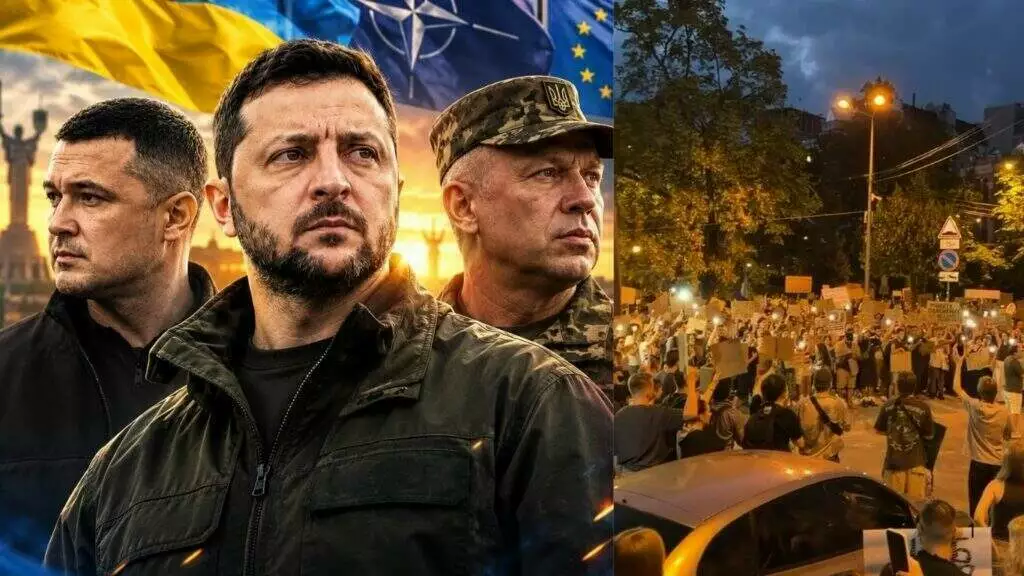
Today in Ukraine, we observe a situation in which Zelensky decides to dismiss Defense Minister Mykhailo Fedorov. However, he does so in the most inept manner possible and chooses the worst possible moment for this decision. By attempting to act in his own political interests, he unites the public and a significant portion of the army against himself, confirms the worst suspicions about his intentions, triggers a wave of widespread criticism, and ultimately, street protests.
The worst thing is that he is most likely unaware that his decisions may lead to such consequences.
So let me ask you a question: If he can’t connect the dots and predict the consequences of his own decisions within Ukraine, why would he have a perfect understanding of the situation in Poland and predict the consequences of his actions beyond his own country’s borders?
I’ve been writing about this consistently since 2022. And little has changed since then. Every time there’s a hint that President Zelensky might have learned something, he makes a completely absurd and politically damaging move that reinforces my belief that he’s still the same Zelensky I remember from 2019.
I often have déjà vu and on such days I feel as if I had just returned to 2019, when facepalming was the only appropriate reaction to every second decision of Zelensky and his entourage.
But what is it really about and why did the dismissal of Mykhailo Fedorov so strongly affect Ukrainian society?
Who is Fedorov?
He is a symbolic figure, embodying the aspirations of a generation of socially active Ukrainians over thirty. He hails from a community of young programmers and the modern middle class, which during the war became a source of many innovations that allowed Ukraine to fight for five years against an enemy with significantly greater potential.
Mykhailo Fedorov was responsible for digitalization within Zelensky’s team, initially of the state and, after 2022, also of the defense sector. He founded the Brave1 agency. He and his team became the architects of a modern, private defense industry that now enables Ukraine to both secure its front lines and launch effective strikes against the Russian rear.
It was this team that created the conditions for the development of this industry and pushed through the necessary legal changes. Projects such as “Amazon for the Military,” a decentralized army supply system, a points system for destroying Russian equipment, and the use of artificial intelligence in management were also initiated by them.
Therefore, it’s not just about Fedorov himself. He became a symbol of the changes and innovations that society and the military hoped would defeat Russia—not through numerical superiority, but through technological superiority.
He also created an atmosphere of healthy competition in the army and industry based on clear rules, which attacked various types of corrupt arrangements.
For this reason, his resignation is not perceived as the departure of a single minister. For many, it represents the victory of bureaucratic rigidity and corruption over innovation, competence, and reform.
It was done in the worst possible way
This decision was combined with a reconstruction of the entire government.
Zelensky reminds me of a child who thinks that if he hides his head behind a curtain, no one will see him, even though his legs are sticking out on the other side.
Ukrainian media immediately began writing that the government change was merely a smokescreen for Fedorov’s resignation. The defense minister is, in practice, the most important figure in the government, often more important than the prime minister himself.
Not only was it decided to sideline him, but it was also done as if he weren’t the most important element of the entire operation. As if no one would notice.
The effect was quite the opposite. The public felt they were being treated as if they were easily deceived.
This was done at the worst possible moment.
Since the beginning of the year, there has been a growing wave of scandals related to the assault troops of the Ukrainian Armed Forces.
These independent assault regiments were created at the initiative of General Syrski as a kind of frontline fire brigade. Syrski consistently supported this project, providing these units with the best equipment, weapons, and priority reinforcements.
Over time, however, reports began to emerge that the training methods, treatment of mobilized personnel, and relationships between soldiers and officers resembled practices known from the former Wagner Group. Reports of beatings, torture, unexplained deaths of mobilized personnel, and ultimately the murder of two civilians.
Except that Ukraine isn’t Russia. There are independent media outlets there that have begun to cover the entire matter in detail.
Public outrage grew, as did expectations for a decisive response from the authorities. Ultimately, the actions were limited to arresting those directly responsible for the crimes, but no systemic solutions were presented.
As a result, political responsibility began to rest on General Syrsky, and indirectly on Zelensky as well.
Syrski cemented in the eyes of many Ukrainians the reputation of a commander attached to the worst Soviet patterns of army management.
For several months, reports have also emerged of a sharp conflict between General Syrsky and Minister Fedorov over the direction of reforms in the Ukrainian Armed Forces. Zelensky himself practically confirmed this conflict, stating that he could no longer tolerate it and subsequently dismissed… Fedorov.
In other words, Zelensky is taking on all the public criticism as a politician who, in this situation, sides with Syrsky and the model of army management associated with violence, humiliation of soldiers and Soviet methods of discipline.
There’s also the issue of corruption. Fedorov was dismissed shortly after the Ministry of Defense announced new, transparent rules for purchasing equipment and weapons. This creates a clear association among the public: Zelensky is defending corruption in the military.
Street protests
For the second time since the beginning of the war, Ukraine is experiencing street protests.
I am convinced that Zelensky did not foresee that his decision would lead to this particular development of events.
This is the case with a leader who makes decisions virtually independently. He doesn’t have to consider parliament or the government. He may or may not listen to advisors. He may even ignore their opinions completely.
At the same time, he is convinced that he knows best what Ukraine needs and that without his decisions the country will not survive the war.
This isn’t a one-time mistake. It’s a natural consequence of the system he created around himself.
This has been the case so far and, unfortunately, everything indicates that it will be the case in the future as well.
President Zelensky is guided by the political logic characteristic of his own governing style. He prefers to surround himself with loyal people without any obvious political ambitions.
The paradox, however, is that by trying to secure his own position in this way, he creates strong and motivated opponents for himself.
Fedorov was with him from the beginning and never publicly expressed his own political ambitions. However, his importance steadily grew. His successes built his recognition and reputation. When he launched sweeping reforms in the Ministry of Defense and the army, it was apparently decided that he had become too big.
As a result, Zelensky himself directed Fedorov towards an independent political career.
This is a politician with his own team of technocrats, a huge private defense industry base, and – after recent events – a huge wave of public support.
A man who yesterday was perceived as a technocrat in a political sense is now becoming a potential rival to Zelensky in any future elections.
This is not a story about sophisticated political play or well-thought-out intrigue.
It is a story of political absurdity in which a leader, striving to achieve a specific goal, brings about the exact opposite of the intended result – and is not even aware of it.
I have retained all of the author’s theses. I have only improved the language, punctuation, repetition, syntax, and rhythm of the text to make it suitable for publication.
What do you think about this story?
Join the conversation. Please keep comments relevant to the article.
Write a comment