

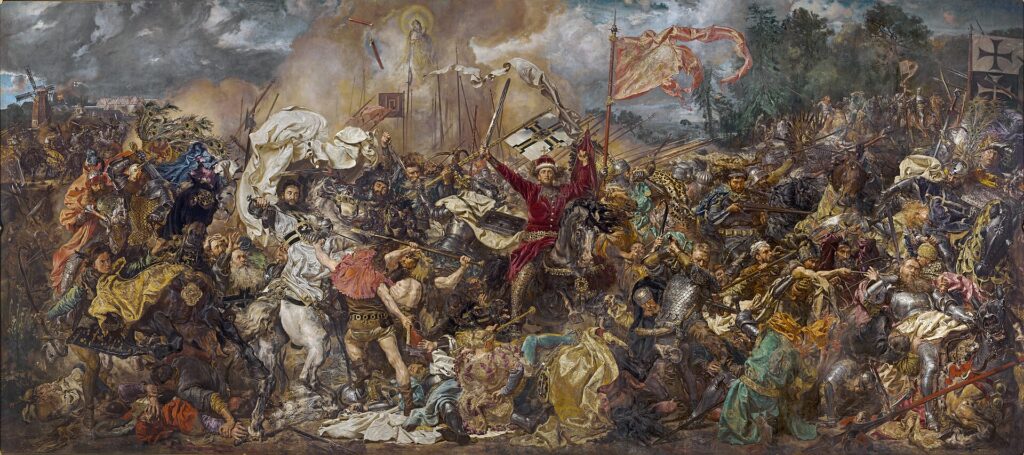
July 15th marked the 616th anniversary of the Battle of Grunwald—a date usually commemorated in a single paragraph on the calendar of anniversaries. Yet, this battle provides a documented, historically confirmed answer to a question often debated today as something new: can diverse nations unite against a common enemy and triumph?


When you talk about “Polish victory at Grunwald”, this is not a mistake – but it is an incomplete picture. Under the command of Władysław Jagiełło and Vytautas stood the Polish knights, Lithuanian banners, Tatar cavalry and – less frequently mentioned – Ruthenian banners (today’s Ukrainian and Belarusian) from Kiev, Lutsk, Halych and Smolensk. Of the entire Lithuanian army, only three Smolensk banners “held their ground” when the Lithuanian wing began to retreat, and despite heavy losses, they broke through to the Polish banners. Jan Długosz, the most accurate, though not impartial towards the Polish side, chronicler of the battle, wrote that of the Lithuanian forces, only Grand Duke Vytautas and the three Smolensk banners deserve praise for their courage.
This is confirmed by the numbers, although they have long been the subject of dispute among historians. — no source from the period left an accurate list of troops, and estimates vary depending on the method of counting used. The Allies had over 30 thousand rides: about 18 thousand Poles and 2 thousand mercenary cavalry, as well as 11 thousand Lithuanians and about 2 thousand Tatars. According to the findings of Professor Andrzej Nadolski, the Teutonic forces numbered about 15 thousand, Polish — 20 thousand, Lithuanian — 10 thousand, organized into 50, 40 and 51 banners respectively. Other estimates indicate a higher number of knights of the Order – even 21 thousand and several thousand infantry.
A simple conclusion can be drawn from these data.. The Lithuanian-Ruthenian forces, numbering 10,000–13,000 individually, stood no chance against the Teutonic Order’s dozens of thousands. The Polish army, numbering around 20,000, could theoretically have balanced the enemy even at the lowest estimates of the Teutonic Knights’ strength, but at higher estimates, it was still numerically inferior. Only the combined Allied forces, numbering 30,000–35,000, provided a clear numerical advantage—and it was this, along with the reserve brought in by Jagiełło at the decisive moment of the battle, that sealed the victory.
And here the paradox of the anniversary is revealed, which has just passed: this date is remembered every year as a fact from the textbooks, but rarely as precedent. A coalition of various nations against a common, imperial enemy had already existed and acted once. It’s worth emphasizing: back then, the threat came from the west and north—from the Teutonic Order in Prussia, not from the east, as it does today from Russia. The enemy’s geography had changed, but the rhetoric remained recognizable—the Order justified its expansion into Lithuanian lands with a mission to Christianize the “pagans,” who had already been officially baptized for over twenty years when the war broke out.
Why do we talk about unity as something new when it has already worked once?
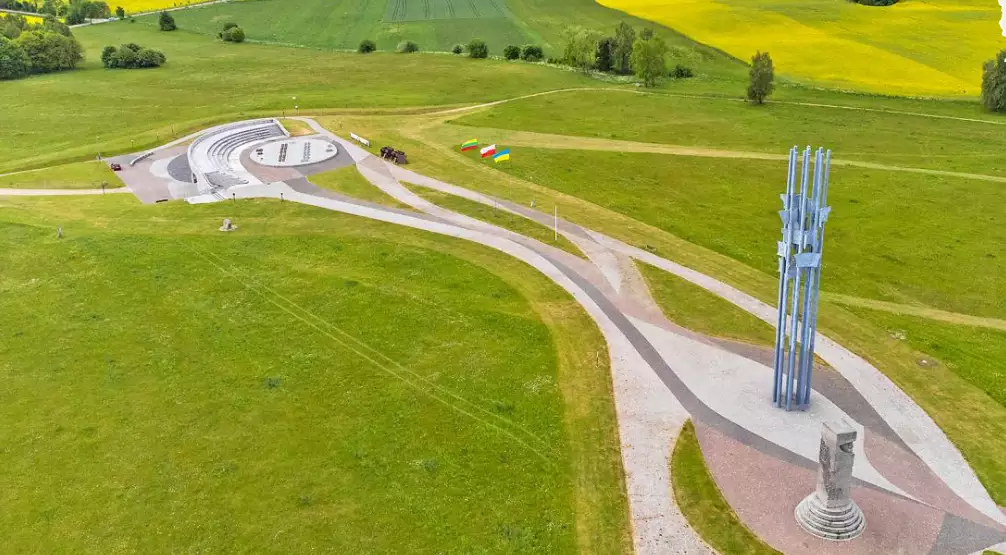
The Battlefield of Grunwald, Source: Museum of the Battle of Grunwald in Stębark
The answer to this question has a specific, historiographical basis. National narratives of the 19th and 20th centuries portrayed Grunwald as a primarily Polish or primarily Lithuanian triumph—every nation building its own historical identity required a founding myth, with no room for an ally who also wanted their share of glory. The Ruthenian (Ukrainian) participation in the battle was subject to a double shadow: Polish historiography traditionally focused on Polish knights, while Soviet, and later Russian, historiography framed Ruthenian banners within a narrative of a “common Old Ruthenian heritage,” rather than as independent participation in a coalition with Lithuania and Poland.
This is not to diminish the Polish or Lithuanian contributions—both were decisive, and it was the Polish knights who took the brunt of the attack in the center and on the left flank. The point is that victory was secured by a coalition, not by one nation acting alone. The three Smolensk banners on the right flank are just one documented episode among many: Czech mercenaries (possibly including the future Hussite commander Jan Žižka) and a Moldavian contingent under Voivode Alexander the Good also participated in the battle.
Today, as Ukraine once again faces an empire that is a common historical enemy for the region—this time, Russia—the question of coalition becomes relevant again. Jagiełło and Vytautas, 616 years ago, resolved the issue in favor of an alliance that recognized the contributions of each side, rather than a more convenient, single-nation narrative.
616 years is not an abstract date from a calendar of anniversaries. It’s a documented, historically confirmed precedent, older than any contemporary dispute over whose version of history is more important. It’s possible to doubt whether the coalition will work again. Denying that it worked once is harder.
The banners were different. The enemy was one. Then, as now.
Source: Nowiny Wschodnie / Polish Army Museum / PAI Media Polska / Wojsko-Polskie.pl / Grunwald Museum

Historian, ethnographer, and social media specialist. She has many years of experience developing YouTube channels, helping experts and businesses build their online presence. She has conducted academic research in ethnopsychology and ethnopedagogy in Galicia and the Northern Black Sea region. Her interests include the history of Ukraine and Europe, Polish-Ukrainian relations, and ethno-national and intercultural issues.
What do you think about this story?
Join the conversation. Please keep comments relevant to the article.
Write a comment