
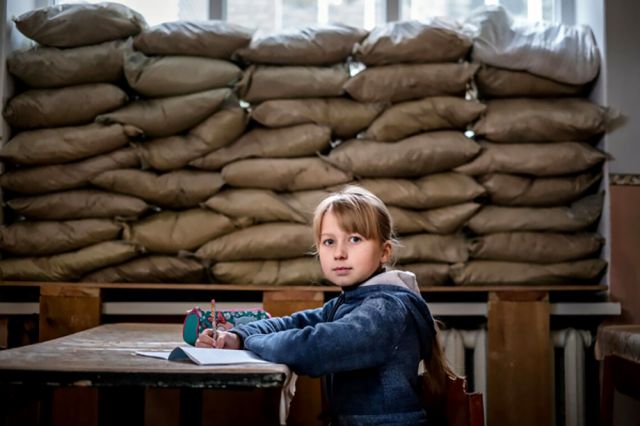
Yelyzaveta Lakshynska is nine years old, and for two years her school has been located at a Kharkiv metro station — this is what her everyday life looks like, as described by a report by Suspilne Kharkiv. Every morning she goes down the stairs, to where not long ago there were only ticket gates and the smell of the underground, and today there are benches, a blackboard, and an aquarium with fish to help calm everyone. “It’s very nice here, safe. I really like it here,” says the girl, quoted in the same piece. What she likes least is not the underground at all, but remote learning — because in an online lesson, as she says, there’s no one to simply chat with during the break.


Yelizaveta is one of nearly twenty thousand children in Kharkiv—four out of ten students in the city—who are studying underground this year. The city already has 21 such underground centers—not only metro stations, but also specially built underground schools and converted radiation shelters by old school buildings, according to the same report. Kharkiv lies only about 40 kilometers from the border with Russia—close enough that sometimes the air-raid siren doesn’t manage to sound before a missile arrives. Just a few years ago, studying underground sounded like an emergency, temporary measure. Today it’s simply how the school year begins in Kharkiv.
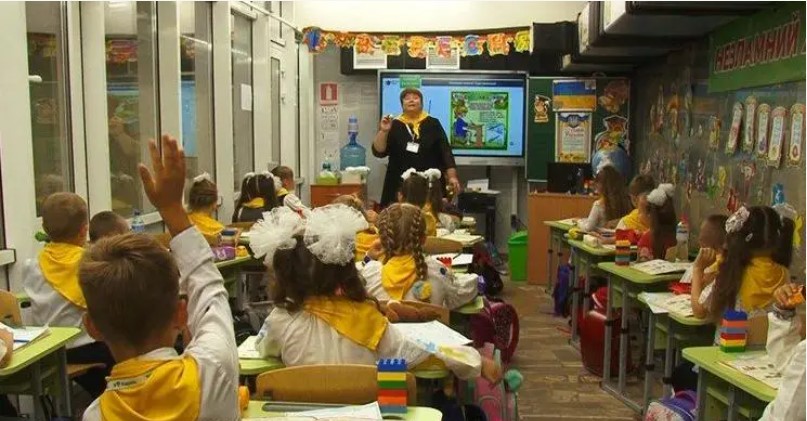
Not all children in Ukraine have been able to have a complete underground school right next to them, like Yelizaveta. In municipalities closer to the border with Russia or the front line—in the Sumy, Kherson, Zaporizhzhia regions—the form of schooling is decided not by the family but by local authorities together with the school, based on one criterion: whether the child can reach a shelter within the time between the alarm signal and a possible strike. In-person schooling in Ukraine begins only in facilities equipped with shelters that allow children to be moved quickly to a safe place. Where there is no such shelter, children stay at home and join lessons through a screen—not because it’s more convenient, but because it’s the only way to continue learning without risking their lives on the way to school.
It is remote learning that has posed parents a question that did not exist before the war: who will stay at home with the child while they sit in front of the screen, and who is supposed to earn a living at that time. The kitchen turns into an office, the child’s room—into a classroom, and parents working remotely say that what is most exhausting is not the work itself, but the need to constantly switch between it and the child—being both a colleague in a meeting and an adult who has to keep an eye on whether the student is really listening to the teacher. Last year in Ukraine a law was passed allowing one of a pupil’s parents, when the child is in remote learning, to switch to remote work with the employer’s consent—but this is more an acknowledgment of the problem at the state level than a solution: the law does not oblige employers to do anything.
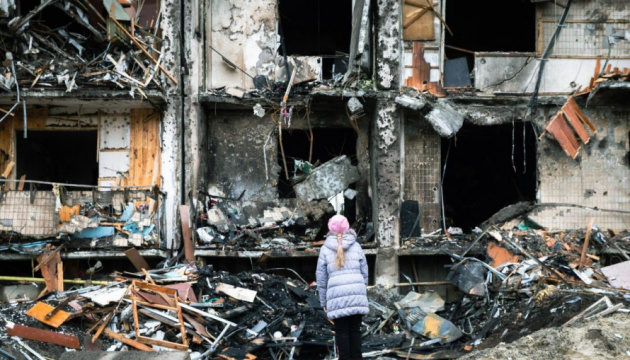
This year’s 1 September in Ukraine does not resemble any of the pre-war ones. In municipalities at elevated risk, it is recommended to forgo mass ceremonies altogether—assemblies, gatherings, a festive crowd in the schoolyard. Where it was nevertheless decided to organize a celebration, the number of participants was limited to the capacity of the nearest shelter. In Pereiaslav—a small town less than 90 kilometers southeast of Kyiv, and thus hundreds of kilometers from the active front line, in a place that until recently was considered relatively calm—the ceremonial assembly had to be postponed this week and moved underground due to a prolonged alert. The celebration still took place. Even distance from the front no longer fully protects anyone.
What does it mean to go on September 1 when there aren’t enough textbooks for everyone?
This summer, Russia has been systematically striking not only schools, but also the sources of textbooks — printing houses and book warehouses. Several million copies were damaged or destroyed, including hundreds of thousands of already printed school textbooks. The effect is concrete: in some classes, there isn’t a textbook for every child—there is only one for two or three students.
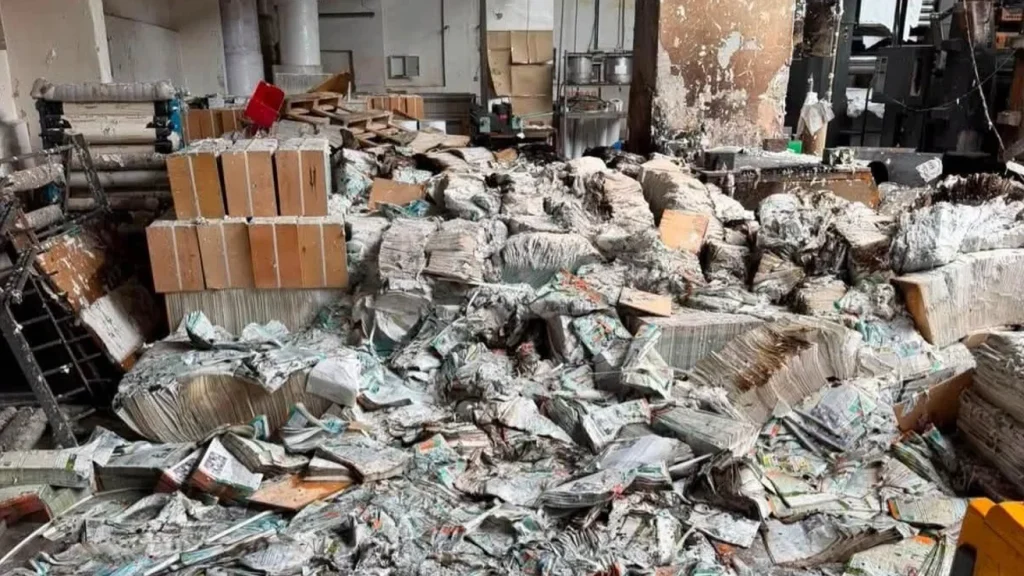
In response, the Ukrainian Book Institute called for these losses not to be met with silence — and one of the first to take up the appeal was the Polish Chamber of Books, which was also supported by the industry portal Wydawca.com.pl. It’s a concrete, human gesture: somewhere in Warsaw or Kraków, someone saw the news about a burned warehouse and decided that staying silent was not an option.
That same evening, when Yelizaveta returns home from class, a resident of Kharkiv, Olena Hrudilina, comes to spend the night at the same metro station — for the fourth year in a row, because her building has no shelter. The same station is a classroom by day; in the evening — a place where adults simply try to get some sleep.
“It’s very nice here, safe. I really like it here” — says Yelizaveta Lakshynska in a conversation with Suspilne Kharkiv, a third-grader at a Kharkiv school in the metro.
Meanwhile, Poland is still debating school shelters in the language of building-code standards — specific requirements still exist only as a draft. The difference is not in square meters underground, but in the fact that a nine-year-old girl already knows where she has class today, while her peers elsewhere are only learning this knowledge — at the price of four years of war.
A lesson interrupted by a siren is not a failure of the learning process. This is precisely the learning process today — the same one in which a third-grader calls an underground metro station simply her school and says she likes it there.
Source: Nowiny Wschodnie / Suspilne Kharkiv / Polish Book Chamber / Rayon.in.ua / Detector Media / Proslav.info / Gazeta Prawna
