
On the illusion of peace, a policy of appeasement, and the dangerous art of getting used to evil


I did not want to write this text. It seemed to me that so much had already been said about Russia’s war against Ukraine that more words would not change reality. And yet there are moments when silence becomes a form of consent to what ought to provoke opposition. That is why I am writing. Not to once again describe the obvious, but to ask when the war ceased to be a constant alarm for the world and became part of everyday life.
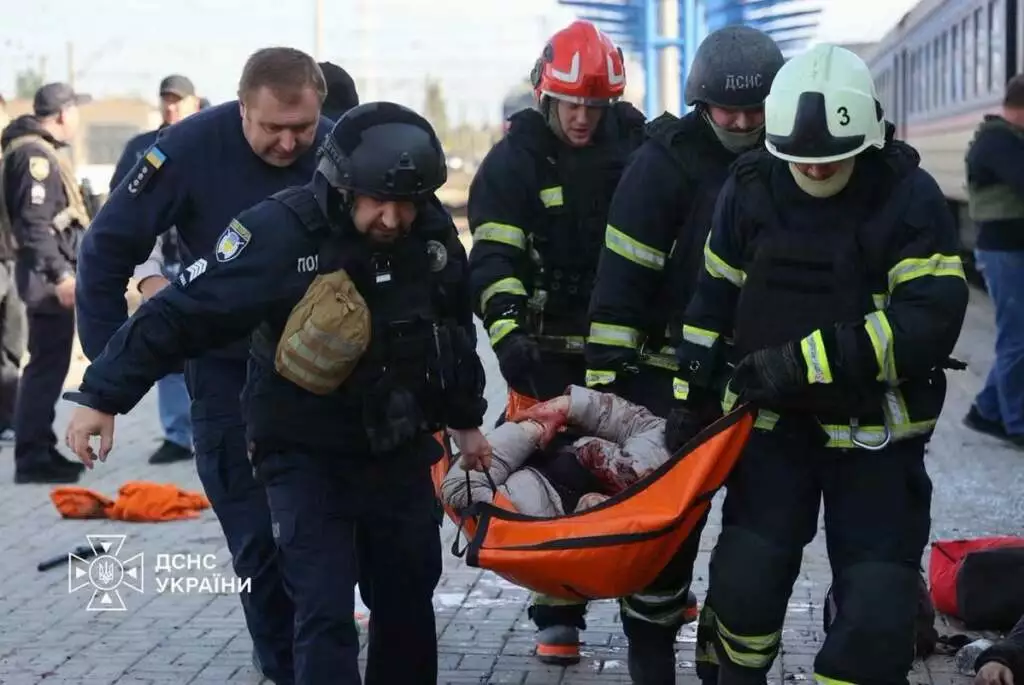
From tragedy to just another announcement
29 October 2026. Dnipro. A Russian drone strikes the platform of a railway station where passengers are waiting for a train to Zaporizhzhia. Fifteen people are killed and 14 are injured in the attack. Among the injured is an eleven-year-old child. This is not a distant front line, a military installation, or an anonymous piece of infrastructure. This is a station, a train, an ordinary space of everyday life. Another Russian attack, more victims, another statement. The information appears in the news, briefly takes up space in the audience’s awareness, and then gives way to the next one. The world notes the tragedy and moves on.
It’s not that everyone has stopped sympathizing with Ukrainians. Aid is still flowing, declarations of solidarity have not disappeared, and many people in Europe are still engaged in activities to support Ukraine. What has changed, however, is the place the war occupies in the collective consciousness. What should shake public opinion is increasingly becoming just another news item of the day. The deaths of civilians stop provoking a lasting reaction, and human tragedies turn into numbers that are easy to remember, but just as easy to leave behind.
The war has not become less brutal. It is the world that is gradually growing accustomed to its brutality.
Behind every number there is someone’s life: a cut-short biography, an empty room, and a family that will not live to see a loved one return. For a European audience, Dnipro may be the name of a city in yet another news story. For its residents, it remains a place where everyday life offers no guarantee of safety, and getting back home is not always something to be taken for granted.
Psychology recognizes the mechanism by which repeated tragedies weaken emotional reactions. We are not able to relive every drama with the same intensity indefinitely. Information fatigue is understandable. This does not mean, however, that we must accept indifference. Between the impossibility of constantly experiencing someone else’s suffering and consenting to its normalization, there is a fundamental difference.
This is precisely where the problem begins—one that goes beyond the psychology of how we receive the news. Habituation shifts the boundaries of social sensitivity. It weakens the sense of urgency, moves the line of what we consider acceptable, and allows a prolonged catastrophe to be treated as an unchanging element of reality. When yet another attack on a Ukrainian city provokes only a brief sigh, the question arises not only about our sensitivity, but also about the political consequences of such a state of affairs.
Can a world that has grown accustomed to war still recognize the mechanisms that lead to its escalation? Does it remember that tragedies do not begin at the moment when the first missiles hit cities? And can it see the moment when the desire to preserve peace begins to serve the entrenchment of conditions that favor aggression?
Peace that was supposed to come through cooperation
For decades, part of the Western political elites believed that Russia could be gradually integrated into the system of international cooperation. After the collapse of the Soviet Union, it seemed that trade would replace confrontation, mutual economic interdependence would reduce the risk of conflict, and dialogue would make it possible to transform a former adversary into a predictable partner.
There was nothing wrong with the very pursuit of cooperation. Diplomacy requires dialogue, and economic relations can foster stability. The mistake appeared when cooperation began to be treated as a universal cure for every problem, and economic benefits obscured questions about the nature of the Russian state, its goals, and its understanding of security.
The Kremlin was gaining access to markets, capital, technology, and political contacts. In many European capitals, the belief persisted that mutual interests would be a sufficiently strong brake on Russian ambitions. Meanwhile, in Russia itself authoritarianism was strengthening, the space for the opposition was being curtailed, historical propaganda was being developed, and political language increasingly invoked grievance, revenge, and an imperial past.
Russia did not become an imperial state only thanks to Vladimir Putin. Imperial notions had a much longer history. However, under his rule they were subordinated to a new political strategy in which the myth of Russian greatness served to legitimize power and justify claims toward its neighbors.
Vast territory, a nuclear arsenal, and the status of a permanent member of the UN Security Council reinforced the belief that Russia deserves special treatment. Its aspirations to have a privileged sphere of influence were often regarded as an element of geopolitical reality that had to be taken into account, rather than being seen as a threat to the sovereignty of other states.
In this way, Russia was receiving not only material benefits. It was also gaining something harder to measure, yet equally important: confirmation that its exceptionalism is accepted, and that its claims can be the subject of negotiations conducted over the heads of the states concerned.
A dragon does not stop being a dragon just because it signs favorable contracts.
Feeding the dragon and political illusions
In the story about a dragon whose owners first consider it useful and later discover they can no longer control it, the most important moment is when care is mistaken for safety. The dragon was fed to keep it obedient, soothed so it would not rebel, and they convinced themselves that getting used to comfort would make it gentle. He, however, interpreted these actions differently: as proof of his own strength and others’ weakness.
This metaphor aptly describes certain mechanisms of Western policy toward Russia. It does not mean that the West created Russian imperialism or that all decisions made after 1991 were wrong. Rather, it shows how political pragmatism can lose touch with reality if its primary goal becomes maintaining the relationship at any cost.
This is particularly evident in energy policy. The Nord Stream 2 project became a symbol of the belief that a direct gas connection between Russia and Germany would strengthen economic interdependence and thus reduce the risk of conflict. Critics, however, pointed out that deepening dependence on a single supplier can become a tool of political pressure and weaken Ukraine’s position.
In 2021, Russia accounted for more than 45 percent of the gas imported by the European Union. Such dependence was not created by a single project or a single decision. It was the result of a long-term policy in which economic rationality was too often separated from a broader understanding of security.
In November 2021, the German regulator halted the certification process for Nord Stream 2 due to the operator’s organizational structure being non-compliant with legal requirements. In February 2022, the German government suspended the certification process after Russia recognized separatist structures under its control in eastern Ukraine.
Only the full-scale invasion made Europe’s energy dependence, for many decision-makers, not just an economic problem but also a direct strategic challenge. The European Union began an intensive reduction of imports of Russian raw materials, and earlier assumptions about cooperation with Moscow started giving way to a security policy.
However, the question remains: why was the risk that had been warned about for years taken seriously only when the war made it impossible to ignore?
A similar mechanism can be described using another literary metaphor: Frankenstein and the creature that slips out of its creator’s control. This is not about equating Russia with a monster or assigning the West responsibility for Russian crimes. It is about the consequences of political decisions that reinforce dangerous tendencies, even though their authors do not intend to bring about a catastrophe.
Sometimes a threat does not arise as a result of one great mistake. It is born of many seemingly rational choices, each of which can be justified on its own. Only together do they form a configuration in which aggressive policy gains more and more room, and stopping it becomes increasingly difficult.
When understanding becomes an excuse
In German political discourse, the term Putinversteher is used to describe a person who understands Putin—sometimes also someone who explains or justifies his actions. Understanding an opponent in itself is, of course, not a mistake. Without analyzing his motivations, ideology, and way of perceiving the world, it is impossible to predict his actions.
The problem begins when explanation gradually turns into justification, and analyzing the causes of aggression pushes responsibility for its consequences into the background.
In Western debate, an argument based on the “yes, but” construction has repeatedly returned. Yes, Russia violated international law, but the West did not take its interests into account. Yes, Ukraine is a sovereign state, but Moscow has its own vision of security. Yes, the annexation of Crimea was illegal, but one must understand the historical determinants of Russian policy.
Such argumentation may give the impression of intellectual balance. In reality, it can be a way of shifting attention from the aggressor’s decisions to circumstances that supposedly forced him to act.
Meanwhile, geopolitical concerns do not give a state the right to attack its neighbor, annex its territory, or question its sovereignty. One state’s security cannot be built by taking away another’s right to determine its own future independently.
The case of former German Chancellor Gerhard Schröder, who after ending his political career maintained close ties with Russian energy corporations, became a symbol of a broader discussion about the boundaries between economic interest and political responsibility. This is not only about one politician, but about a way of thinking in which economic relations with Russia were for far too long treated as a value in and of themselves.
The West’s mistake was not that it tried to understand Russia. It was that at times it was easier to explain its behavior than to draw conclusions from what that behavior meant for the security of other states.
Diplomacy that cannot draw the line between compromise and acquiescence can, unnoticed, become a tool of adapting to aggression.
From Georgia to Ukraine: successive tests of boundaries
The war did not begin in February 2022. The full-scale invasion was another stage in a process whose earlier signals could have been noticed much earlier.
In 2008, Russia used military force against Georgia and then recognized the independence of Abkhazia and South Ossetia, regions remaining outside the control of the Georgian authorities. It was a signal that Moscow was ready to use force to influence the political course of neighboring states.
That same year, at the NATO summit in Bucharest it was announced that Ukraine and Georgia would become members of the Alliance. However, no specific timetable for their accession was set, nor were they provided with protection that could effectively shield them from Russian pressure.
In 2014, Russia seized Crimea and illegally annexed it. In eastern Ukraine, a war began that claimed thousands of lives and for many years changed the lives of millions of people. The West imposed sanctions, but it did not manage to stop further escalation. A significant part of the economic ties survived, and diplomatic attempts to stabilize the conflict did not bring lasting peace.
The years 2014–2022 were not a period of peace for Ukraine in the full sense of the word. It was a time of war, losses, political pressure, and constant threat. At the same time, in some European capitals there remained hope that the conflict could be frozen and relations with Moscow gradually rebuilt without a fundamental change in existing policy.
It is impossible to prove that a different response to the events of 2008 or 2014 would certainly have prevented the later invasion. History does not allow us to test alternative scenarios. However, it can be stated that the actions taken after 2014 were not sufficient to stop Russia from starting a much larger war.
Each time, the Kremlin tested the limits of what it could do without incurring costs deemed unacceptable. Each time, the international community had to decide whether its principles would remain declarations or would be translated into consistent action.
It is precisely in this sequence of events that one of the most important problems of European security policy lies: not every concession leads to another act of aggression, but the lack of effective deterrence can reinforce the aggressor’s belief that the risk of further escalation is acceptable.
Ukraine as a problem of the Russian imperial imagination
In July 2021, Vladimir Putin published a text devoted to the historical unity of Russians and Ukrainians. In it, he presented the history of both nations in a way subordinated to a vision of their civilizational community, and he largely questioned the independence of Ukraine’s political development.
It was not merely a dispute over how to interpret the past. The text revealed a way of thinking in which Ukraine’s sovereignty was not treated as an indisputable political fact, but as a problem to be resolved in line with Russian historical notions.
It is precisely here that the myth ceases to be just a story about the past. It becomes a program for action.
For if one accepts that a neighboring nation in fact has no distinct political history, and that its statehood is accidental or artificial, it becomes easier to question its right to independently choose alliances, a political system, and a direction of development. In this view, Ukraine’s independence becomes for the Kremlin not so much a reality that must be respected as an obstacle on the road to rebuilding an imperial sphere of influence.
In February 2022, this logic took the form of a full-scale invasion. Russia tried to impose on Ukraine its own vision of its history, statehood, and future by means of military force.
The West responded with extensive military, financial, and humanitarian assistance, further sanctions, and a change in its approach to European security. It would be unfair to reduce the entire Western policy to indifference. Many countries undertook real and costly actions in support of Ukraine.
This does not, however, change the question of earlier mistakes. Could a more consistent response to the events in Georgia and in Crimea, less energy dependence on Russia, and more effective deterrence have influenced the Kremlin’s calculations? We do not know the answer. We do know, however, that the earlier model of relations did not prevent the war.
The imperial myth is dangerous not only because it falsifies the past. It becomes particularly destructive when it serves to deprive other nations of the right to exist independently.
Europe remembers, but does it draw conclusions?
Two world wars left Europe with an experience that was meant to serve as a warning against nationalism, expansionism, and policies that justify violence. The history of the 20th century showed how dangerous concessions to a state that consistently expands its claims can be, and how high a price is paid for recognizing the threat too late.
This does not mean that today’s Russia should be unreservedly equated with Nazi Germany, or that today’s Europe should be equated with the interwar period. Historical analogies require caution. Political systems, circumstances, and international conditions differ. However, political mechanisms can be compared: dismissing revisionist ambitions, believing in the possibility of a lasting agreement without effective deterrence, gradually accepting an aggressor’s claims, and reluctance to acknowledge the threat until it becomes direct.
Historical memory does not work automatically. One can know the history of Hitler, the Holocaust, and the Second World War, and still fail to recognize contemporary forms of authoritarian propaganda and imperial policy. One can take part in ceremonies commemorating the victims of past catastrophes, while at the same time getting used to the idea that a stronger state claims the right to decide about the territory and future of a weaker neighbor.
The problem is not always a lack of knowledge. Sometimes it lies in unwillingness to apply that knowledge in political practice.
History is not an instruction manual that allows us to predict the future precisely. It is, however, a source of warnings. It does not relieve us of the need to think; rather, it takes away the convenient excuse that we could not have seen any signals.
War as just another piece of news
Let’s return to the Dnipro. Fifteen people are dead. Five were injured. These numbers matter, but they do not tell the whole story. They do not show the fear that remains after an attack, the family conversations held in uncertainty, or ordinary activities that suddenly become a test of courage.
For the people of Ukraine, the war is neither a metaphor nor a subject of debate about the effectiveness of European diplomacy. It is an everyday experience. For some European audiences, however, it becomes an event that can be followed or ignored, depending on interest and the current flood of information.
That is precisely why getting used to the war is so dangerous. It can lead to a situation in which the public stops demanding consistent action, politicians begin to treat a prolonged conflict as inevitable, and solidarity turns into a ritual repeated on successive anniversaries and after tragedies.
Let us not expect the world to experience the war every day as if it had started yesterday. This is neither possible nor necessary. But let us expect that it will not mistake information fatigue for consent, nor habituation for normality.
Solidarity is not about constantly declaring emotions. It is about the ability to sustain action even when attention weakens and headlines stop moving people. It means real support for Ukraine, political accountability, media reliability, and the understanding that Ukraine’s security is not a problem distant from Europe’s security.
Nor is it about assigning collective guilt to Western societies. Responsibility for starting and waging the war lies with the Russian leadership. However, analyzing the political mistakes that preceded the invasion remains necessary if we want to reduce the risk of a similar scenario recurring.
Russian imperialism did not arise because the West traded with Russia. Not every attempt at dialogue was a mistake, and not every compromise meant weakness. The problem was that some Western elites for too long believed that economic interdependence in itself would restrain political ambitions, and that a pursuit of stability could replace a consistent response to aggression.
They did not create Russian imperialism, but their decisions may have helped it retain room to grow. Just as successive concessions do not have to automatically lead to war, declarations of peace likewise do not guarantee security if they are not accompanied by credible boundaries and a willingness to defend fundamental principles.
Dragons do not become safe because you feed them with good intentions. And political delusions do not become wisdom just because you call them pragmatism.
The highest price of shortsightedness is not lost profit or a failed diplomatic scenario. It is human life—the life that must be given up when the threat one refused to see finally slips out of control.
That is why it is not enough to ask how many more such news items we will see. We must ask what we will do so that they do not become an inseparable part of Europe’s everyday life.
I did not want to write this text. But when the death of innocent people becomes just another piece of information, and war becomes something you can get used to, silence is no longer neutral.
This forces us to think. And to speak. But thinking without action remains powerless, and words without consequences become yet another ritual. The question is no longer whether the world understands what is happening in Ukraine. The question is whether it is ready to draw the consequences from that understanding.
Literary scholar and researcher specialising in culture, identity, Polish-Ukrainian relations, and sociocultural processes in Central and Eastern Europe.
For many years, he has combined academic, educational, and civic activities in Poland and Ukraine. His research interests include cultural borderlands, collective memory, postcolonial processes, and intercultural interactions. He is the author and co-author of several monographs and more than 150 academic publications.
He has extensive academic and organisational experience. He has held senior positions at universities in Poland and Ukraine, led research teams, and implemented international research and educational projects.
He is actively involved in supporting the Polish community in Ukraine, particularly in Berdiansk and the southeastern part of the country. His work focuses on cultural heritage preservation, education, and documenting the experiences of communities affected by war and occupation.
In his publications and commentaries, he examines the Russo-Ukrainian war, Polish-Ukrainian relations, Polish diaspora communities in Central and Eastern Europe, politics of memory, and questions of national and cultural identity. He also addresses Russian propaganda and imperial narratives.
In recognition of his academic, cultural, and civic contributions, he has received several distinctions, including the Knight’s Cross of the Order of Merit of the Republic of Poland, the Medal for Merit to Culture – Gloria Artis, and the Honorary Badge “Meritorious for Polish Culture”.
What do you think about this story?
Join the conversation. Please keep comments relevant to the article.
Write a comment