

I am writing this on November 5th. It has great emotional significance for me. This day is the anniversary of the act of self-immolation committed by a former UPA fighter. Vasyl Makuch set himself on fire exactly 58 years ago. He was protesting against the Russian invasion of Czechoslovakia and the Russification of Ukraine. Thanks to the work of outstanding historians Petr Blažek and Łukasz Kamiński, we can learn about the extraordinary deed of a man who, after being released from prison, should have sought peace and a life for his family. Instead, he chose death. Death to open the eyes of others, to awaken conscience. I must admit that learning about Makuch was quite a shock to me many years ago. Like every Pole, I don’t have a high opinion of the UPA, so knowledge reached me slowly. And yet, it was no one else, and they were partisan from the UPA He sacrificed his life in a spectacular way to protest the Russian invasion of Czechoslovakia. He did so in the spirit of nonviolence, but in its most shocking form. Sometimes it’s worth stepping outside your bubble and examining the knowledge you’ve acquired from so many books, which lacked that one. It was missing because no one had written it yet. Now it’s here, and it’s worth taking advantage of..


It’s not for me to judge the justification of his actions. You can disagree with him, you can have different opinions. However, Makuch demonstrated undeniable heroism and demonstrated his love for his homeland and freedom. In Poland, in the same protest almost two months earlier, former Home Army soldier Ryszard Siwiec set himself on fire. And while Siwiec is quite well known in Poland, Makuch is very little known in Ukraine. Who was this Ukrainian and UPA member?
Source: janpalach.cz / Wasyl Makuch, 1927-1968
I wrote about three characters – a Czech, a Pole, and a Ukrainian – back in January of this year. Those interested can read this article – click here. HERE.
From armed combat to Soviet gulag
Vasyl Makuch was born in 1927 in the town of Kariv in the Lviv region. The village now lies on the Polish-Ukrainian border. Like everyone else at the time, he was a Polish citizen. His parents had eight children, whom they imparted a patriotic upbringing to. His older brothers and sister were known locally as Ukrainian activists.
At the age of 17, Makuch joined the Ukrainian Insurgent Army (UPA) in 1944, using the pseudonym “Mykola.” He fought against Russian forces in western Ukraine. In February 1946, during one of the numerous clashes with Russian forces at that time, he was shot in the leg. His unit retreated, and he sought refuge with a Polish peasant. Shortly after, a Russian patrol found him weakened and bleeding. Seeking help in a Polish home at that time was not a good idea. Poles were observed and deported to Poland or to camps in the far north of Russia. Despite this, there is no evidence that the Polish peasant betrayed him. Makuch was likely caught during a routine search of possible hiding places.
After a swift trial, a Russian military court sentenced Makuch to 10 years of forced labor in camps, five years of deprivation of civil rights, and confiscation of his property. He served his sentence in the gulag system in Siberia and Mordovia. It is certain that, like most Ukrainian prisoners in the camp, he lived with Poles, former enemies. Many Ukrainians and Poles understood as early as 1945, and others only in the camps, that only by sticking together did they have a chance of survival. And so they did. Poles and Ukrainians in the camps helped each other, and when necessary, even liquidated informers. The rule was that if the informer was Ukrainian, the Ukrainians dealt with him. If he was Polish, the Poles dealt with him. This was to avoid accusations of ethnic hatred, as this would be lethal for the prisoners. What was the “dealing” process like? First, the prisoner received a warning. If he didn’t react and continued to report, he would suffer an “accident,” most often fatal.
Russified Dnipro and the fight for the soul of the nation
After serving his full sentence, Makuch was released in 1956. Like all former Ukrainian prisoners, he was administratively banned from returning to western Ukraine, and so settled in Dnipro, in the east of the country. Poles released from labor camps were also banned from traveling to western Ukraine. If they failed to obtain permission to travel to Poland, they often headed to Zhytomyr and the surrounding area, where, despite the Russian genocide, a Polish community of several thousand still lived.
Wasyl Makuch’s sister, Paraska, described her brother’s condition and attitude after returning from many years of imprisonment:
“Despite the physical exhaustion of working in Soviet labor camps, his spirit remained unbroken. I remember how much it pained him to see eastern Ukraine every day, where, upon his return, he was forbidden to speak his native language, a situation he viewed as a systematic murder of the soul of his own nation.”
In Dnipro, Makuch took up manual labor and started a family with Lidia, whom he met during his exile. At home, the family spoke Ukrainian, which, in the city’s Russified milieu, led to systematic conflicts with the ruling Russians. By this time, Dnipro had already been subjected to systematic Russification for many years. Ukrainian elites were murdered or deported to other parts of Russia, and in their place, only Russian-speaking teachers, officials, and management staff were brought to work in factories. Anyone considering higher education had to pursue studies in Russian. Consequently, Ukrainian was only taught in a handful of schools. This was the process of denationalizing all of Ukraine. Of course, Ukrainians still constituted the majority of the population, but they were intimidated and tried to avoid offending the Russians.
He and his wife, Vasyl Makuch, had two children: a daughter, Olha, and a son, Volodymyr. Ukrainian was the only language spoken in their home. Ukrainian culture and language were cultivated, and Ukrainian literature was read aloud. This caused difficulties for the children. In school, they were called “Banderites” as early as the 1960s. In Poland, this term only gained popularity many years later, thanks to the constant work of Russian collaborators. In Dnipro, however, it was a significant issue. Children were persecuted for their Ukrainian language and subjected to ridicule, orchestrated by Russian teachers. In the atmosphere of fear that prevailed in the countries occupied by Russia, no one defended the oppressed ordinary people.
Flames on Khreshchatyk and KGB revenge
On November 5, 1968, the day before the state commemoration of the October Revolution, Makuch arrived in Kyiv. He had everything planned. He had been preparing for this act for at least two months. On the city’s main street, Khreshchatyk, at house number 27, not far from Bessarabsky Market, he doused his clothes with gasoline and set himself on fire.
Eyewitnesses to the incident reported the course of events:
“The burning Makuch caused an absolute shock, running in the flames and shouting: ‘Down with the communist colonizers!’ and ‘Glory to Ukraine!’ and ‘Down with the occupiers of Czechoslovakia!'”.
Vasyl Makhukh died on November 6, 1968, in a Kyiv hospital from burns covering 70% of his body. After his death, the Russians immediately took steps to conceal information about the protest, and—following the principle that those around him were also to blame—Vasyl Makhukh’s family was repressed. KGB officers launched an investigation, attempting to link Makhukh’s actions to the alleged conspiracy. Makhukh’s niece, Yaroslava, described the intelligence services’ operational methods immediately after the tragedy:
“Officers raided the homes of his relatives, turning everything upside down in search of alleged nationalist conspiracies, literature or foreign connections.”
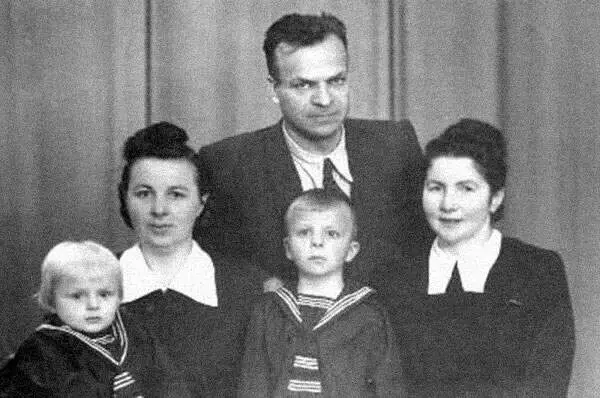
Source: janpalach.cz / Wasyl Makuch with his family
The main blow from the security services and propaganda machine fell on her immediate family. They were placed under constant surveillance, and Lidia Makuch was summoned for interrogation. The repression also had a social dimension, involving isolation and open harassment. Historical accounts and family memoirs record the consequences of these actions:
“Instead of sympathy, immediately after the tragedy she was subjected to brutal interrogation by the KGB. The authorities sought to completely erase the memory of her husband, and Makuch’s children were subjected to harassment at school and called ‘Banderites’ by their indoctrinated surroundings.”
Sister Vasyl’s husband recounted that his wife, Paraska Osmylovska, was summoned for questioning on November 7th. There, she was tortured. Upon release, her lungs were lacerated from beatings and she was coughing up blood. She died two years later from complications.
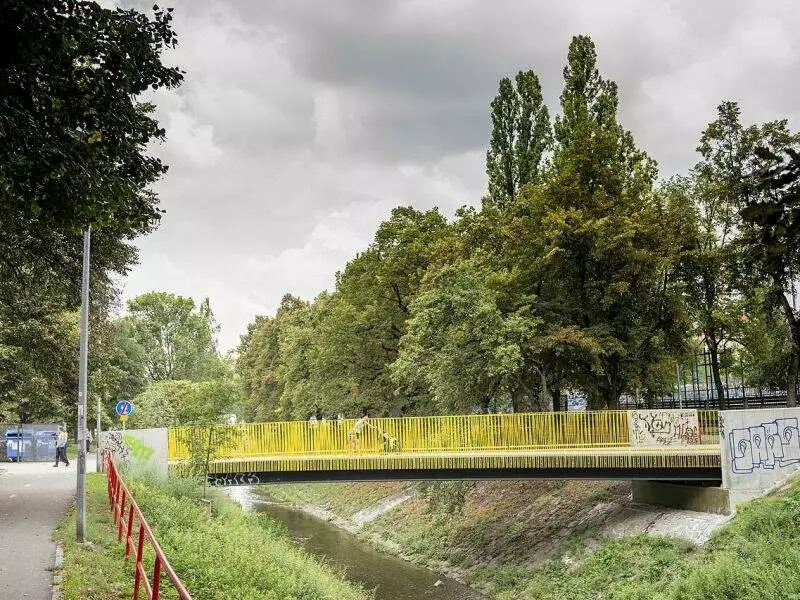
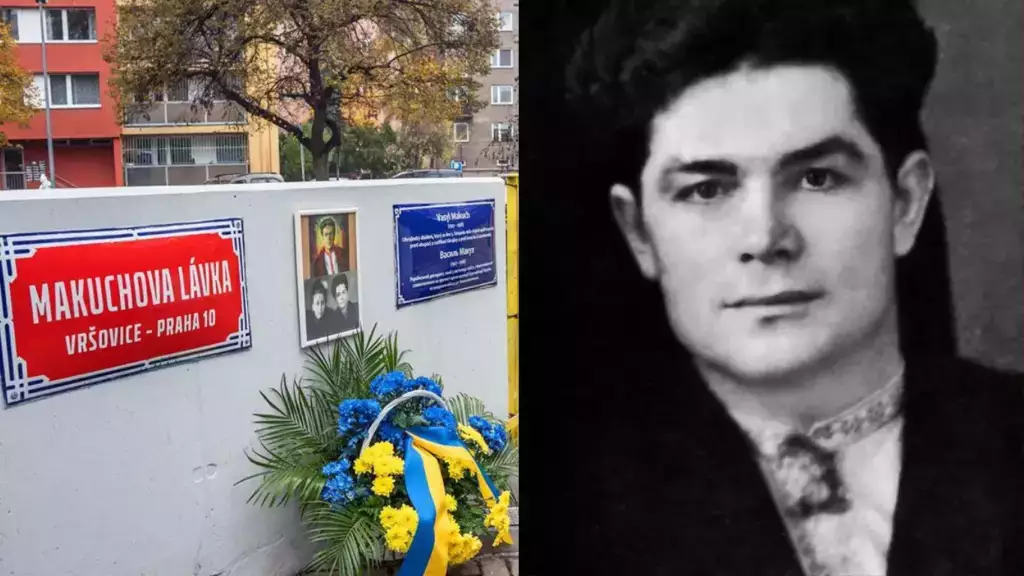
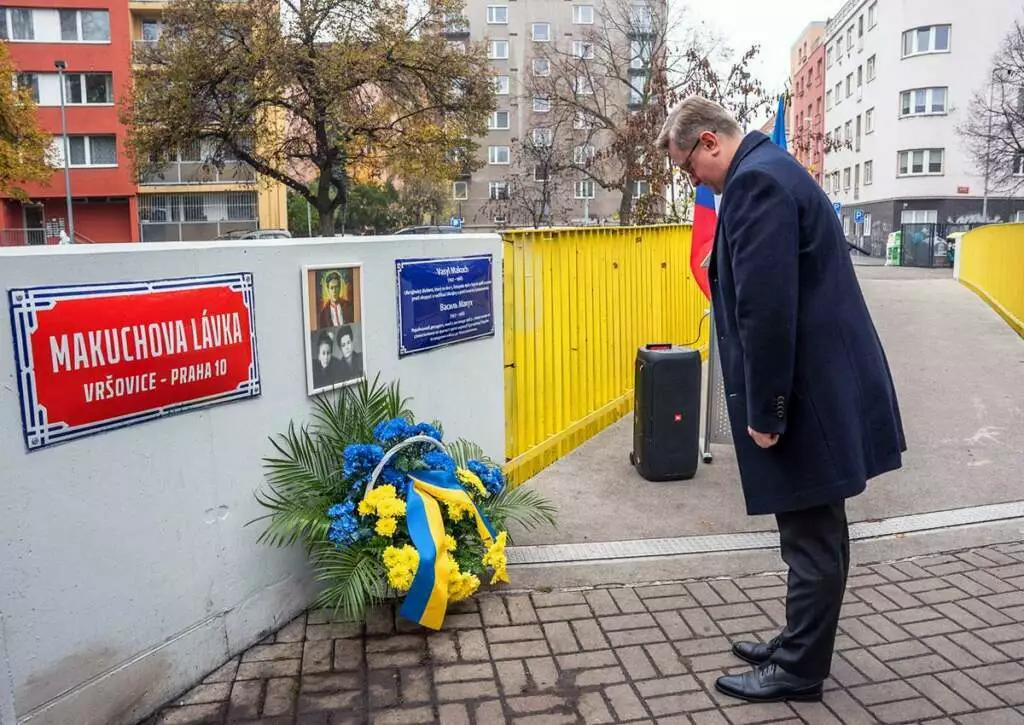
A pedestrian bridge in Prague named after Vasyl Makuch. Author: Fotonauta, source: Wikimedia commons
Learning the story of another man who committed self-immolation (previously, years ago, there were Ryszard Siwiec, Jak Palach, and other Czechs), I was, as usual, not only intrigued but also overcome with emotion. It’s not easy to read the biography of someone who died. And it’s especially difficult for someone who undoubtedly died a martyr’s death by self-immolation. People like Vasyl Makuch wanted to shake consciences and incite resistance. They failed, although their actions began to be discussed years later. In both Makuch’s and Siwiec’s cases, their stories were only learned after our countries regained freedom. Unfortunately, there is still little information about Makuch in Ukraine. He seems to be better known in the Czech Republic, where he receives significant attention during anniversaries related to the Russian invasion of 1968. In Prague, there’s a bridge named after Makuch, called “Makuchova Lavka,” located in Prague 10. Every year on November 5th at 3:30 PM (4:30 PM in Ukraine, when Makuch set himself on fire), a gathering is held there, where he is remembered, flowers are laid, and his deed is spoken of. Also, in the birthplace of the Czech Living Torch, Jan Palach, in Všetaty, the local museum displays Vasyl Makuch. Czechs remember. It’s paradoxical that the memorial plaque in Kyiv honoring Makuch was created at the considerable initiative of Czechs. Should it be that foreigners care more about the memory of, say, a common hero? An explanation, but not an excuse, is that the Russians ensured Makuch’s memory faded away. However, decades have passed since independence. Ukrainians speak of the creation of a Pantheon. Doesn’t this man deserve to be placed there? Shouldn’t the sacrifice of his life, when others were trying to live comfortably, be appreciated? Vasyl Makuch is still waiting.
Dear Ukrainians, this is a bit of a shame. Change it.

What do you think about this story?
Join the conversation. Please keep comments relevant to the article.
Write a comment